Physical Address
304 North Cardinal St.
Dorchester Center, MA 02124
Physical Address
304 North Cardinal St.
Dorchester Center, MA 02124

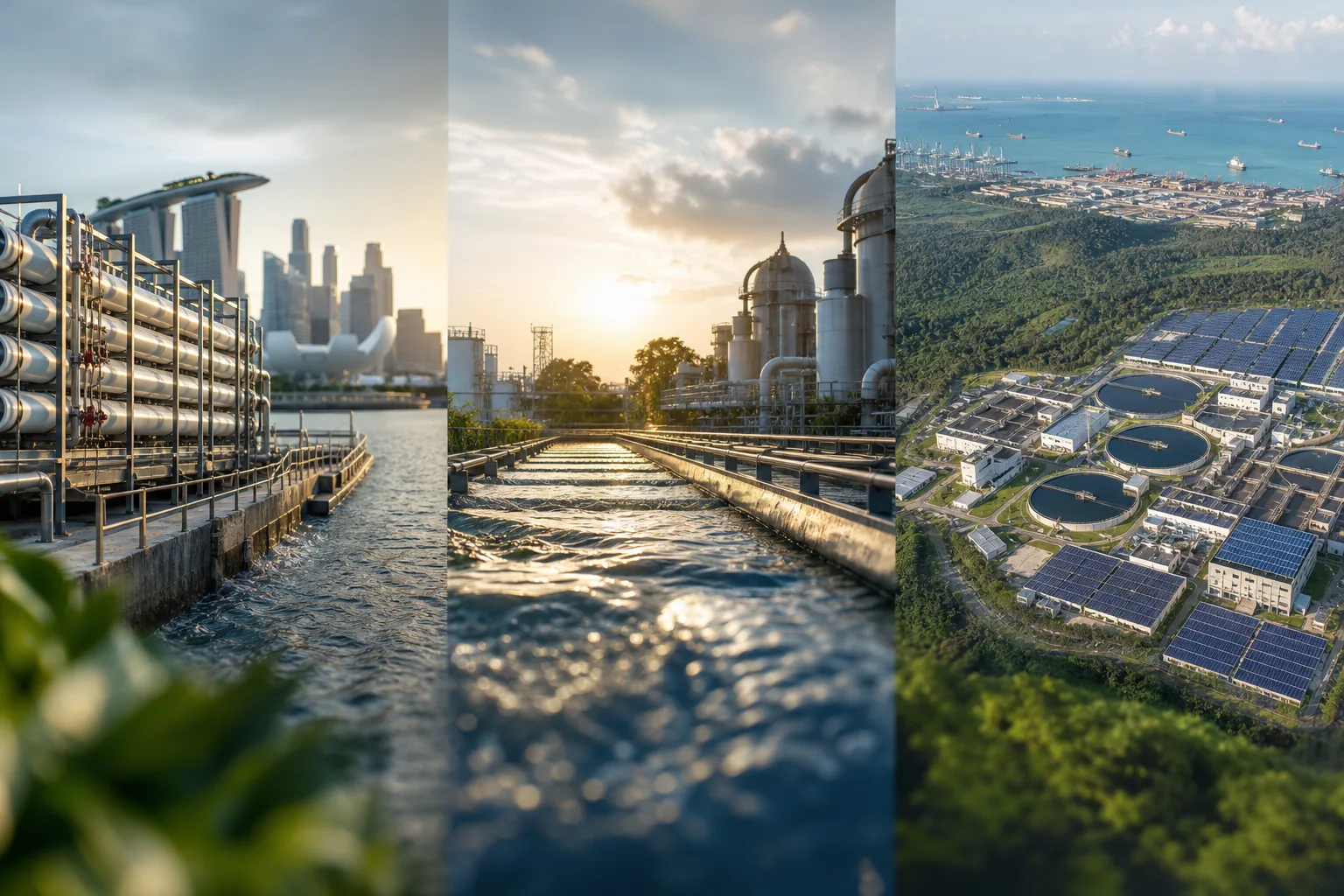
This article evaluates three practical approaches to harness salinity gradient power in Singapore, emphasizing feed compatibility, integration, and pilot testing for real-world feasibility.
If you’re assessing salinity gradient power in Singapore, your desalination plant is already running, but concentrated brine is leaving the process with no obvious next use. Electricity demand, discharge controls, and production targets compete for attention while a potentially valuable stream moves toward disposal. The practical question is whether your brine remains a liability or becomes a resource.
Most Singapore projects don’t have a salinity-gradient power problem. They have a feed-quality, integration, and governance problem. Salinity-gradient power means using the difference in salt concentration between two fluids to create energy, much like the natural contrast between fresh water and seawater. You can’t assume that a suitable river-estuary system exists at your site.
Your decision should be grounded in your actual streams. This shortlist tests which route deserves a Singapore feasibility study by comparing feed compatibility, process integration, approval responsibilities, monitoring requirements, and the path from brine to value.
You need more than a salinity-gradient concept when your Singapore site has desalination brine, industrial wastewater, limited space, and strict discharge controls. You also need to know whether those streams can support power generation, resource recovery, or lower-carbon operations.
This shortlist applies a repeatable test: compare feed compatibility, integration effort, approvals, carbon value, and evidence maturity before treating any route as a business case.

The research identifies two membrane-based pathways for converting salinity differences into useful power, Reverse Electrodialysis and Pressure-Retarded Osmosis, according to the University of Twente. The shortlist also includes MediSun Energy’s integrated brine-management route, although site data is still needed to validate its fit. Generic ocean-energy concepts and unsupported commercial claims remain outside scope.
Separate demonstrated process behaviour from theoretical potential. The University of Twente records both membrane pathways as developed in the 1970s and 1980s, while the International Renewable Energy Agency frames assessment around technical, cost, market, and policy dimensions.
Practical rule: Treat evidence maturity as a screening criterion, not a guarantee of commercial performance.
Can ion movement turn your Singapore brine stream into electricity? Yes, if you pair a concentrated stream with a dilute stream and control the interfaces between them. RED sends salt ions through alternating cation- and anion-exchange membranes, creating an electrical potential that you can collect as power.
A promising mechanism isn’t enough, however. IRENA explains that a salinity difference drives ion transport and creates an electric potential for conversion into electricity, while the University of Twente describes salt ions moving from concentrated solution towards a less concentrated stream in RED. The real question for your site is how the stack performs under actual brine conditions.

RED suits you when direct membrane-based power belongs inside a brine-management train. You can test desalination concentrate against a suitable dilute industrial or treated water stream, while engineering partners assess hydraulics, pretreatment, electrical collection, and future integration.
RED snapshot: Concentrated brine and dilute water flow through alternating membrane channels. Ion movement produces voltage. Pilot data decides whether that voltage remains useful after fouling, scaling, and cleaning demands.
RED’s limitation is development risk. You must test membrane selectivity and durability, stack design, pretreatment, electrical collection, and performance with your actual streams. Characterise the brine and dilute feed first, then validate the stack and plant integration at pilot scale.
Use it if you can provide matched streams, pilot access, and the engineering discipline to earn a scale-up decision from measured Singapore performance.
Can osmotic pressure support power generation at your Singapore site? Yes, in principle. PRO moves water through a semipermeable membrane from a dilute stream into a pressurised concentrated salt solution, with that pressure driving a turbine or other power-conversion equipment.
Unlike RED, which converts ion movement into electricity, PRO depends on water transport, pressurisation, membrane performance, and hydraulic balance. You need compatible streams, room for pressure equipment and pretreatment, and a practical connection to existing water infrastructure. The University of Twente describes water moving from the less concentrated solution towards the concentrated salt solution.
Singapore fit snapshot: Your brine and dilute stream may look compatible on paper, but flow timing, pressure, footprint, and pumping loads decide whether the arrangement works in practice.
PRO suits you when a desalination or industrial water process already has matched hydraulic streams and space for membranes, pumps, pretreatment, and power recovery equipment.
PRO adds pressurisation energy, hydraulic complexity, membrane risk, and footprint requirements. You must protect reliable desalination output while measuring net power, not gross turbine output.
Use it if you can verify flow, salinity, pressure, membrane performance, and net power with your actual Singapore streams.
A power device may not address the wider needs of a Singapore site. If your operation also manages desalination brine, industrial waste streams, carbon targets, and discharge obligations, the project needs a broader assessment.
MediSun Energy combines Reverse Electrodialysis with brine management, resource recovery, and CO₂ mineralization. You can assess the route as a project architecture for operators, manufacturers, engineering partners, and public programmes, rather than as a promise that one device solves every waste problem.
Site view: You route desalination brine and a compatible industrial stream through an integrated assessment, then test energy recovery, recovered-resource value, carbon handling, offtake, and approval requirements together.
You have a Singapore site where desalination brine or industrial waste must be managed alongside energy and decarbonisation goals. Reverse Electrodialysis may sit within that wider system, provided you confirm feed compatibility, plant interfaces, and a credible destination for recovered outputs.
You must characterise chemistry, contaminants, flow variation, and compatibility before sizing the system. You also need recovered-resource buyers, conservative carbon accounting, clear equipment interfaces, and assigned responsibilities for monitoring and approvals.
Use it if your Singapore project needs brine, waste, carbon, and resource value assessed together, with MediSun Energy judged against the whole-site case rather than electricity output alone.
A global headline can’t replace a local test. Your feed streams, plant interfaces, approvals, and resource offtake will determine the value of a Singapore project.
A review is a Singapore-specific feasibility assessment of your concentrated and dilute streams, process compatibility, net energy, cost, risk, governance, and resource value. You examine brine flow, industrial wastewater, contaminants, variability, pretreatment, available space, electrical integration, approvals, and potential buyers. A global potential estimate cannot replace evidence from your actual site.
Salinity gradient means a difference in salt concentration between two fluids. You may have a concentrated stream, such as desalination brine, beside a dilute stream, such as treated water. The difference creates the energy opportunity, but your flow rate, composition, temperature, contaminants, and operating pattern determine whether that opportunity is useful.
Blue energy is the broader renewable-energy idea of capturing energy released when solutions with different salinities mix. Salinity-gradient power is the wider concept, while Reverse Electrodialysis and Pressure-Retarded Osmosis are membrane-based conversion pathways. Research from the University of Twente estimates a theoretical potential of 2.6 TW, above global electricity consumption of 2.0 TW, but that is not a Singapore plant forecast. Your local feed, integration, governance, and offtake decide practical value.
Your first decision is not RED or PRO. It is whether your Singapore site has two usable streams, stable chemistry, and a workable plant interface.
Start with measured conditions, not a theoretical energy estimate. A feed-first brief gives you a defensible basis for technology, approvals, partners, and offtake decisions.
For your selected desalination plant or industrial site, identify concentrated and dilute streams, including internal process water rather than assuming seawater and freshwater are the only options.
Prepare one page today for one Singapore site. Show the streams, interfaces, data gaps, decision gates, and proposed next test. You may find MediSun Energy suitable as an integrated partner for a properly scoped study, but the feed evidence must lead.
If you want a faster way to test this, MediSun Energy can scope feed-stream mapping, integration review, and resource-recovery options for desalination operators, industrial manufacturers, water technology firms, and public agencies through its brine-management and energy insights for a properly defined study.




