Physical Address
304 North Cardinal St.
Dorchester Center, MA 02124
Physical Address
304 North Cardinal St.
Dorchester Center, MA 02124

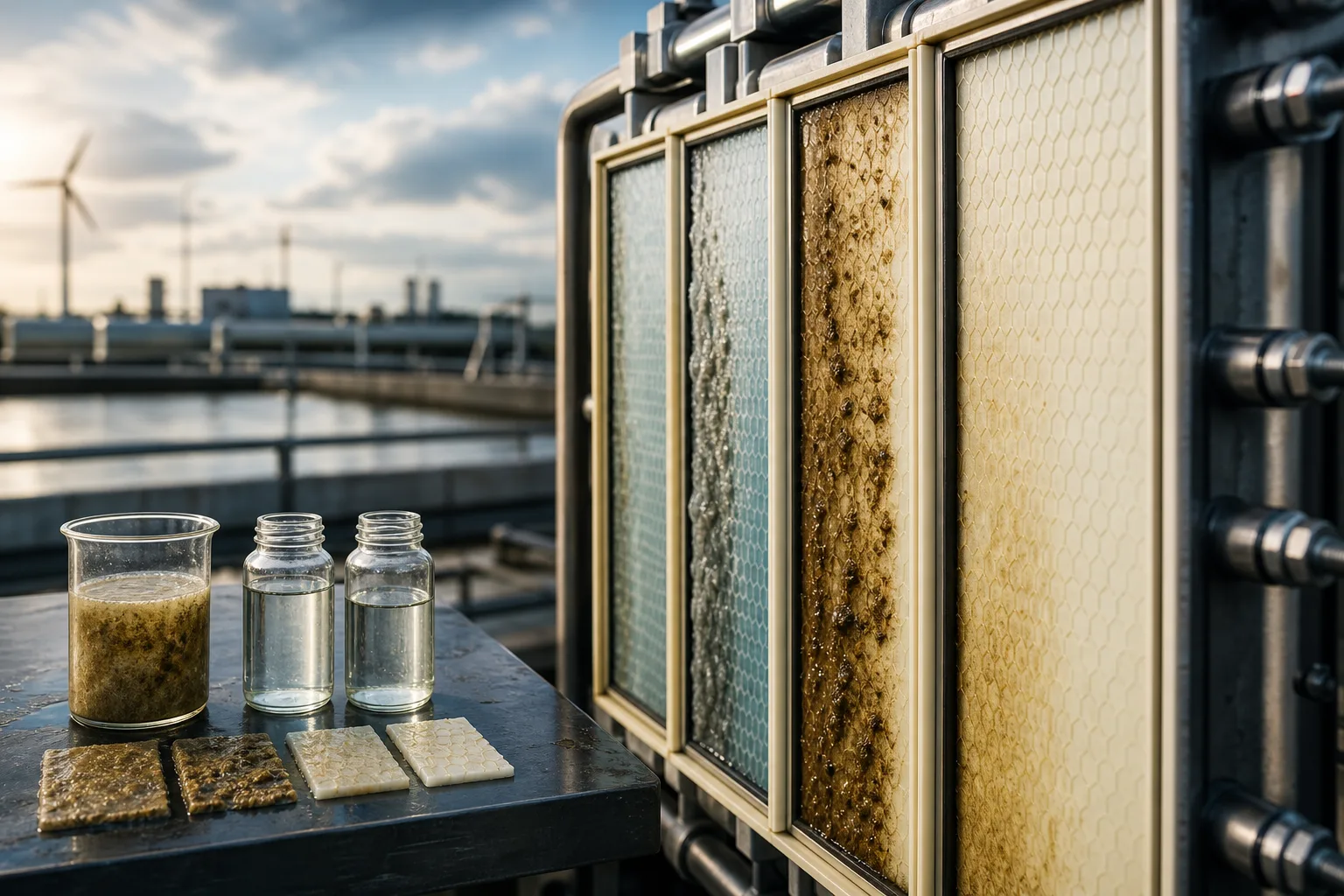
Discover how to differentiate membrane fouling from ageing in Reverse Electrodialysis systems to improve maintenance decisions and extend membrane life in brine and industrial pilots.
You’re at the control desk when the RED stack shows another drop in voltage efficiency. Pressure drop is rising, and your team is split between cleaning the stack, replacing membranes, or changing pretreatment. You need to distinguish membrane lifetime from fouling in Reverse Electrodialysis systems before a desalination-brine or industrial-stream pilot loses another operating window.
Most RED stacks don’t have a simple membrane-lifetime problem. They have a fouling-control and evidence problem. Eindhoven University of Technology reports that unmanaged fouling and scaling reduce power density, increase membrane electrical resistance, and weaken permselectivity. Magnesium, calcium, and sulfate ions can also raise resistance, reduce permselectivity, and lower net potential through uphill transport.
That distinction matters for your Singapore pilot, whether you’re managing brine to value or testing industrial waste streams. MediSun Energy brings a circular brine-management context, but your site still needs condition-specific pretreatment and evidence. The method below helps you separate fouling from membrane ageing, choose the first corrective action, and protect membrane life without assuming a universal cleaning interval.
A voltage drop does not prove that your RED membranes have reached the end of their life. You may be seeing higher resistance, weaker selectivity, or changed surface behaviour while the membrane sheets remain physically intact.
That distinction protects your Singapore operation from the wrong response. If you replace membranes before checking feed chemistry, you pay for unnecessary parts, cleaning, lost power efficiency, and a diagnosis you still cannot defend.

Commercial Fujifilm anion and cation exchange membranes showed substantial mechanical stability during evaluations lasting multi-month or year-long periods, according to the Technical University of Denmark. You can use that evidence to question an age-based replacement decision, not to promise a fixed service life for every desalination brine or industrial waste stream.
“A membrane can remain mechanically stable while organic foulants, humic substances, and localized pH shifts alter its surface and polymer matrix,” according to the Technical University of Denmark.
Your condition record needs two separate findings: whether the membrane is physically damaged, and whether its transport performance has changed. A stack that is still intact is not necessarily still performing.
Dissolved organic carbon can bind with divalent and trivalent metals, creating larger foulant structures that change transport pathways. Organic foulants, humic substances, and local pH shifts may also alter the membrane surface and polymer matrix over time, according to the Technical University of Denmark. Collect feed samples and readings for pH, conductivity, pressure drop, and stack output before calling that change ageing.
Weak target: “Clean the RED stack when voltage falls below the normal range.”
Strong target: “For the Singapore brine pilot, sample DOC, calcium, magnesium, pH, conductivity, pressure drop, and voltage efficiency at each performance deviation before approving chemical cleaning.”
Practical rule: Control and document feed chemistry first, then separate reversible fouling from irreversible membrane degradation before declaring the end of life.
For MediSun Energy pilots, this approach supports brine to value and resource recovery decisions without treating one membrane supplier’s durability result as a warranty. MediSun Energy brings integrated brine-management experience, but site-specific chemistry still limits how far any pilot result can travel.
Keep cleaning records beside laboratory results and operating data. You’ll then reduce unnecessary cleaning, identify lost efficiency earlier, and set a more defensible replacement plan for your own stream.
A RED stack rarely gives you one clean fault signal. You may see lower voltage, higher pressure drop, or changing flow while the feed chemistry shifts underneath the process. A repeatable check keeps your Singapore pilot from treating every output change as membrane ageing.
Use the same sequence each time: establish the clean condition, trend the signals, identify the foulant route, then clean only after pretreatment has been reviewed. That sequence turns a general fouling concern into a maintenance decision you can defend.

Record voltage, current, flow, pressure drop, feed condition, operating state, and sampling time after commissioning or a confirmed compatible clean. This baseline is the reference for every later comparison.
Before: “Clean when voltage looks low.”
After: “At 09:00, RED Stack A ran on the Jurong industrial brine blend; voltage, current, flow, pressure drop, and feed sample were logged before cleaning.”
Trend the signals together, not in separate spreadsheets. A voltage change with stable hydraulics points to a different investigation from rising pressure drop with altered feed quality.
| symptom | likely cause | first fix |
|---|---|---|
| Output changes after current-direction reversal or flushing | Fouling remains incompletely characterized despite a self-cleaning measure | Compare the result with the clean-stack baseline and inspect feed chemistry |
| Organic loading is suspected but the foulant route is unclear | Natural organic matter interactions with ion-exchange membranes are only partially understood | Sample and characterize the feed before selecting a cleaning cycle |
| Performance drifts during changing feed conditions | Feed chemistry is changing the fouling environment | Log feed composition alongside voltage, current, flow, and pressure-drop trends |
Elsevier’s 2021 review describes frequent current-direction reversal in electrodialysis reversal as a way to combat ion-exchange membrane fouling. It also says natural organic matter interactions with metal ions remain only partially understood. Reversal and flushing help, but neither replaces diagnosis.
Use the chemistry record to separate organic, inorganic, biological, and particulate routes. Adjust filtration, clarification, antiscalant control, or other pretreatment before selecting a cleaning cycle compatible with the membrane and spacers.
Before: “Run the standard acid wash.”
After: “Confirm the suspected mineral deposit, check membrane compatibility, correct upstream solids control, then approve the selected cleaning cycle.”
Repeat the baseline measurements after cleaning under the same operating state. Record the cleaning action, recovery observed, remaining deviation, feed condition, and next inspection date. MediSun Energy can apply this evidence framework when integrating RED into circular brine-management projects, while site chemistry determines the defensible lifetime assumption.
A RED stack can lose performance because an operating habit hides the real foulant. You may reverse current, flush the channels, and still leave deposits attached to the membrane surface.
For brine and industrial-stream pilots, the first response should connect the visible symptom with feed chemistry, hydraulic behaviour, and a stable baseline. It shouldn’t trigger an automatic cleaning cycle.
| symptom | likely cause | first fix |
|---|---|---|
| Progressive resistance increase with declining electrical performance | DOC has chelated divalent or trivalent cations and promoted membrane-surface bridging | Sample DOC and relevant metal ions together before changing the cleaning program |
| Visible or inferred surface fouling despite current reversal | Ternary metal-DOC-membrane complexes remain attached | Treat reversal as a control measure, not proof that fouling is removed |
| Pressure drop or flow deterioration | Fouling has clogged flow channels | Confirm the hydraulic trend and inspect the feed and stack condition before cleaning |
| A single unstable reading suggests end-of-life | Transient operating or feed conditions have been mistaken for permanent degradation | Repeat the measurement and compare a stable post-cleaning result with the baseline |

Current reversal and routine flushing can limit accumulation, but they don’t prove that attached material has left the stack. Dissolved organic carbon has strong chelating behaviour and can form complexes with divalent and trivalent cations, according to Elsevier’s 2021 research. The research also describes metal-DOC-membrane complexes that can promote surface bridging.
If your voltage remains low after reversal, check the hydraulic trend and sample the feed before repeating the cycle. Treat reversal as one control measure, not a complete fouling diagnosis.
Cleaning without identifying the foulant can expose your membranes to an unsuitable chemical environment while leaving the deposit largely unchanged. Check DOC alongside calcium, magnesium, and other relevant ions, then confirm that the membrane chemistry permits the proposed treatment.
A single unstable voltage, resistance, or pressure reading can reflect feed variation, temperature, flow, or instrumentation drift. Repeat the measurement under a stable operating state and compare it with the baseline and post-cleaning result before declaring the membrane’s life exhausted.
Your pilot record should show feed chemistry, flow, temperature, electrical output, pressure drop, cleaning action, and recovery. Without those conditions, you can’t separate permanent degradation from a temporary upset. MediSun Energy can use this record in circular brine-management pilots, although site chemistry still sets the defensible lifetime assumption.
Your next pilot run should begin with evidence, not an assumed service life. A clean-stack reading, matched feed samples, and consistent operating records give you a defensible comparison when output changes.
Fouling may mean channel clogging, membrane scaling, or another harmful membrane interaction, according to Eindhoven University of Technology. Your lifetime assumption belongs in the operating record, not in a copied datasheet value.
Before your next run, create one page with space for the stack identity, membrane type, feed source, operating state, readings, samples, cleaning events, and inspection notes. A weak entry says, “Performance reduced.” A stronger entry says, “RED-01, clean start, 25°C feed, 2.1 bar, outlet conductivity recorded, concentrate sample stored.”
Record the clean-stack baseline before you change treatment. Sample both feed and concentrate, then trend electrical and hydraulic indicators under comparable conditions. Research at the University of Twente measured an averaged thermodynamic efficiency of 44.9% with Fujifilm Type 10 ion-exchange membranes, but you should treat that result as historical research context, not a transferable target.
Define the reading that starts an investigation, the chemistry that justifies sampling, and the evidence required before cleaning. Investigate organic fouling and metal-bridging fouling separately. Apply only pretreatment or cleaning that matches the suspected mechanism and membrane compatibility.
MediSun Energy can use this evidence trail when integrating Reverse Electrodialysis with circular brine management and CO₂ mineralization. Site chemistry still determines whether a lifetime assumption or performance result is defensible.
If you want a faster way to do this, MediSun Energy develops evidence-led RED integration plans, brine-management pathways, and CO₂ mineralization options for desalination operators, industrial manufacturers, engineering firms, and public-sector project teams. You can review MediSun Energy’s brine-management and RED insights before defining your pilot evidence trail.