Physical Address
304 North Cardinal St.
Dorchester Center, MA 02124
Physical Address
304 North Cardinal St.
Dorchester Center, MA 02124

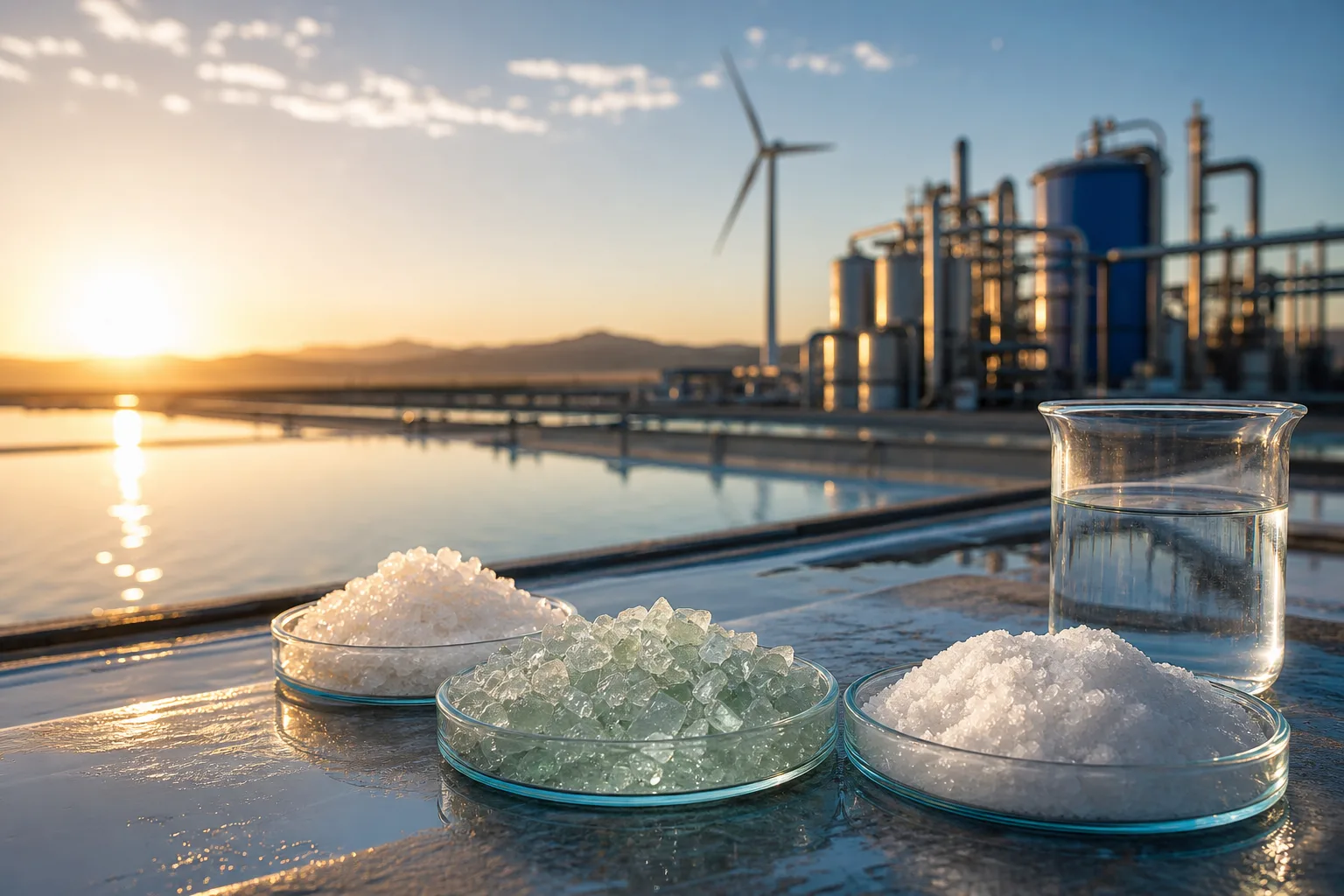
This guide explains how to evaluate brine streams, select recovery technologies like Reverse Electrodialysis and CO₂ mineralization, and avoid costly failures in mineral recovery projects.
You watch the discharge line while your plant keeps paying to concentrate, handle, and release a stream that still contains water, energy potential, and minerals. The economics of mineral recovery from brine begin with that existing cost, whether the stream comes from a desalination site or a factory.
Monash University reports that brine discharge can threaten the environment while leaving substantial resources unexploited. Most brine operators don’t have a disposal problem. They have a resource-selection problem. You need to identify the material that fits your feed, process energy, contaminant profile, and market.
The phrase sounds simple until you ask which mineral, at what purity, and for which buyer. You may recover value, but only when the product specification and outlet support the process.
The useful work lies in screening your feed, testing the economics, spotting attractive-looking failures, and choosing a credible next step. MediSun Energy brings Reverse Electrodialysis and CO₂ mineralization into that assessment, alongside a circular approach rather than a promise that one technology suits every brine.
You already carry the cost of brine discharge, energy use, monitoring, and compliance. Mineral recovery from brine only improves that position when the recovered material reduces the whole management burden, not when it adds a costly separation step beside it.

Your screening decision needs more than a promising mineral name. Test recovery yield, contamination, conditioning costs, residual-brine handling, and a credible buyer before the project earns investment attention.
For you, the wrong target can create a second waste stream. A process may produce a saleable fraction while still requiring expensive treatment for the remaining brine, extra energy for concentration, and tighter controls for discharge. A 29-page 2021 Desalination review from Monash University covers regulation, water, energy, mineral recovery, and laboratory, pilot, and industrial cases. That breadth shows why you cannot assess recovery as an isolated separation step.
“Sustainable brine management is critical for utilizing untapped water, energy and mineral resources within brine because of more stringent environmental regulations and the need for more cost-effective desalination processes,” Monash University wrote in its 2021 review.
Your feed may contain useful salts, yet dilution and contaminants can weaken the economics. A 2022 ScienceDirect study reported salt recovery from reverse-osmosis brine ranging from 20% to 50%. Treat that range as a cited screening input, not a Singapore benchmark.
You must then ask what that percentage means commercially. Recovery value depends on product purity, conditioning cost, residual-brine disposal, energy consumption, and offtake requirements. A high recovery rate does not rescue a product that fails a buyer’s specification.
Use the following test before commissioning detailed trials. If the target mineral does not improve your existing disposal, energy, compliance, and sales baseline together, the project may be waste treatment with an attractive label.
Practical rule: Screen a mineral only when its recovered value can improve your whole brine-management baseline after conditioning, residual handling, energy, compliance, and offtake costs.
Your Singapore project must fit site-specific discharge obligations, energy conditions, available space, and buyer requirements. A desalination operator, industrial manufacturer, and public infrastructure agency will not face the same baseline, even when their streams contain similar salts.
MediSun Energy combines Reverse Electrodialysis and CO₂ mineralization within a circular brine-management approach, although feed variability and product-quality requirements still limit what each route can achieve. Technical screening comes before treating recovery as an investment case.
You cannot select a recovery technology from the product name alone. Your feed chemistry, ion concentration, contaminants, energy conditions, and buyer specification decide whether recovery is practical.
Mineral recovery from brine is a chain, not a single machine. You first characterize and pre-treat the stream, then concentrate or fractionate ions, separate the target, convert it into a stable product, and condition that product for sale.

Your desalination brine may contain commercially extracted minerals such as sodium, potassium, magnesium, and calcium, according to ScienceDirect. Boron, lithium, and rubidium require a different screening question because trace concentration and competing ions can make selectivity more valuable than total salt loading.
If your Singapore brine contains sodium or lithium alongside magnesium and calcium, nanofiltration may create more useful fractions. Water Online reports that nanofiltration separates monovalent ions from multivalent ions. Functionalized polymers, including amidoxime-based adsorbents, can selectively trap trace lithium or uranium from reject streams, according to ScienceDirect.
Your route should follow four decisions: characterize and pre-treat the feed; concentrate or fractionate the ions; separate the target; and convert and condition the product. Reactive precipitation, for example, can convert magnesium ions into solid magnesium hydroxide, according to Springer Nature.
| Situation | Better move | Why |
|---|---|---|
| The feed contains a useful mix of monovalent and multivalent ions, including sodium or lithium with magnesium or calcium. | Screen nanofiltration as a fractionation step before downstream recovery. | Nanofiltration can separate monovalent ions from multivalent ions, creating more selective downstream streams. |
| Lithium or uranium is present at trace concentration in a reject stream. | Evaluate a selective adsorbent such as an amidoxime-based functionalized polymer. | Functionalized polymers are designed to selectively trap trace metals rather than recover all dissolved salts indiscriminately. |
| Magnesium concentration and chemistry support conversion to a solid product. | Test reactive precipitation for magnesium hydroxide formation. | Reactive precipitation can convert magnesium ions into a collectable magnesium hydroxide solid. |
| The brine has sufficient salt loading and evaporation conditions are technically and economically acceptable. | Assess staged evaporitic recovery and collect precipitated solids. | Evaporitic mining removes water until solid products precipitate, but evaporation energy and product purity must be checked. |
Your project may use MediSun Energy’s Reverse Electrodialysis within an integrated train where ion movement and energy efficiency match the feed. It is not a universal substitute for nanofiltration, adsorption, or precipitation. Feed fouling, membrane selectivity, and the required product specification still control the result.
If your industrial waste stream contains suitable ions and your process provides a compatible carbon dioxide source, CO₂ mineralization may convert dissolved components into stable mineral products. MediSun Energy connects that pathway with brine management, although product markets and impurity controls still determine whether the recovered material has commercial value.
You can have an attractive mineral target and still have an unworkable project. The failure usually begins before technology selection, when a concept relies on assumed chemistry rather than your measured brine or industrial waste stream.
Brine mining can avoid fresh water for extraction and avoid creating contaminated water or disposal waste, according to Water Online. That benefit remains conditional. Evaporitic recovery depends on removing water until solid products precipitate, then collecting them, according to Ansys.

You should not begin with lithium, magnesium, or potassium. Begin with laboratory results from representative samples taken across operating conditions. Your file should cover major ions, trace contaminants, pH, temperature, suspended solids, and seasonal variation.
A concentrated ion is not automatically a saleable product. You still need to test precipitation, evaporation, adsorption, or membrane separation against scaling, selectivity, variability, and yield. MediSun Energy can connect Reverse Electrodialysis with brine management, but feed compatibility and downstream product value still limit the result.
You need a buyer, reuse route, or specification before you optimise recovery. For CO₂ mineralization, test your industrial waste stream’s composition, contaminant profile, handling requirements, and resulting product quality before making a decarbonization claim.
Compare the proposed process with your existing pumping, concentration, treatment, monitoring, and disposal duties. Count energy, chemicals, maintenance, residuals, and transport. A partial calculation can make an expensive route look profitable.
Your first obstacle is usually not choosing a mineral. It is proving what your brine contains, how it changes, and what your current management route already costs. Without that evidence, your store of useful salts can remain an attractive theory.
You need one documented stream before you compare technologies, partners, or buyers. A 2021 Monash University review covers water, energy, and mineral recovery routes for sustainable brine management, with examples from laboratory, pilot, and industrial scales. Its record shows 97 Scopus citations, which supports its relevance as background, not proof that a route will work at your Singapore site.
Record your brine source, flow, temperature, operating hours, existing treatment, pumping load, chemical use, discharge route, and monitoring duties. Include the cost of handling the stream today. You need a baseline before any recovery benefit can be tested.
Collect recent analyses across operating conditions, not one convenient sample. Test major ions, suspended solids, organics, metals, silica, scaling tendency, and contaminants that could affect separation or product acceptance. Record flow variability beside each result.
Choose a target mineral only after you define its buyer, purity, moisture, particle form, packaging, and permitted impurities. Your target may be a saleable product, an industrial input, or a recovered intermediate. Each route demands different quality evidence.
Build one mass and energy balance covering concentration, separation, drying, chemicals, residuals, transport, and discharge. Test whether Reverse Electrodialysis or CO₂ mineralization fits your existing equipment and energy profile. Count avoided treatment costs, not only potential product revenue.
Use laboratory results to define a pilot, then test quality, recovery, fouling, uptime, and residual handling. Check your Singapore site constraints, discharge obligations, integration partner, and offtake conditions before approaching MediSun Energy about a suitable integration pathway.
If you want a faster way to build this evidence, MediSun Energy supports desalination operators, industrial manufacturers, engineering firms, and public agencies with brine management, resource recovery, Reverse Electrodialysis, and CO₂ mineralization integration. You can review practical guidance in MediSun Energy’s brine-management articles before discussing a project.




