Physical Address
304 North Cardinal St.
Dorchester Center, MA 02124
Physical Address
304 North Cardinal St.
Dorchester Center, MA 02124

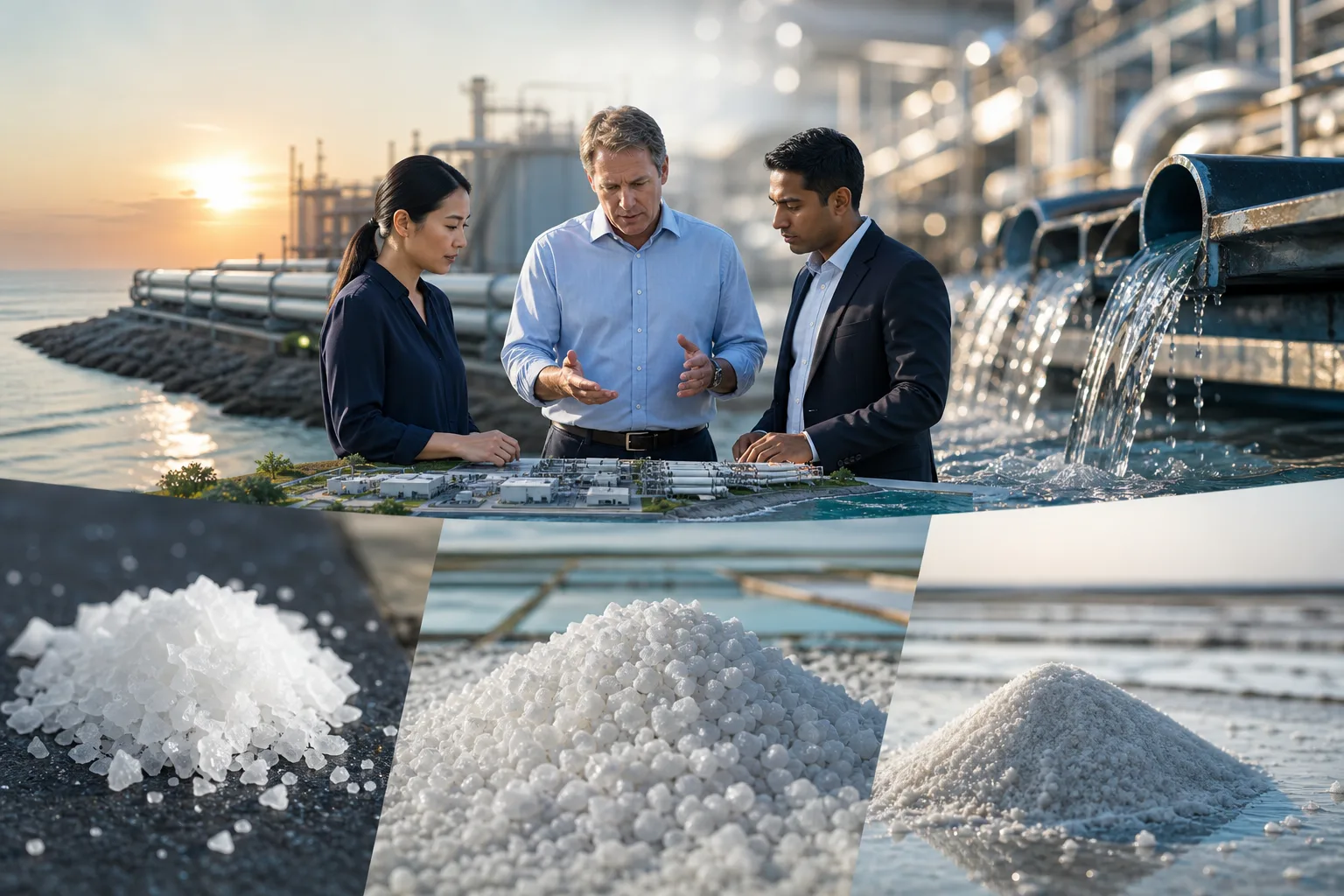
Explore three effective salt recovery methods from desalination brine, including evaporation, membrane fractionation, and integrated electrochemical processes, to optimize your plant's sustainability and economics.
You see the problem at the end of a shift: a concentrated brine stream is leaving your desalination plant, while disposal costs, environmental scrutiny, and pressure to decarbonize keep rising. You need a practical way to reduce that burden without adding a process that consumes more energy than the plant can spare.
Salt recovery from desalination brine can turn part of that liability into a resource, but recovery isn’t automatically profitable. Feed chemistry, energy demand, product purity, equipment footprint, and access to buyers all shape the result. A salt that looks valuable on paper may still be uneconomic once treatment, concentration, maintenance, and transport are included.
A project team needs a route matched to the plant, not a mineral-value pitch. This comparison examines evaporation and crystallization, membrane fractionation, and integrated electrochemical and CO₂ mineralization trains for a Singapore project, using SGD and the actual discharge, power, footprint, and integration limits. MediSun Energy can support that integrated brine-management design, although the right route still depends on feed testing and a credible product buyer.
Your brine may contain valuable minerals, but concentration alone does not prove commercial viability. AZoMining reported that desalination brine can contain source minerals at twice the concentration found in regular seawater. The same publisher projected global desalination capacity at 90 to 150 million cubic metres per day, making route selection relevant to your plant, not just to laboratory research.
The research covers both multi-mineral recovery programmes and focused membrane studies. An operator needs one screen across them: feed data, product specifications, energy demand, disposal reduction, and fit with Singapore infrastructure.

Evaporation may suit available heat, while membrane fractionation can favour selective products. Electrochemical and CO₂ mineralization trains may reduce disposal and create different products, but you still need to test pretreatment, electricity demand, purity, and downstream handling.
Practical rule: Do not rank a route by mineral value until you have matched its energy source, product specification, and disposal reduction to your plant.
Your feasibility model should show capital cost, electricity or heat demand, residual brine handling, product revenue, and operating risk in SGD. Can your plant supply spare electricity or heat without affecting water production? This screen ranks the routes by project fit, not by headline mineral value.
For a solid product from desalination brine, evaporation and crystallization are the most intuitive route. Water is removed, the brine reaches supersaturation, crystals form, and the solids are separated while the remaining liquor is managed.
The product risk is clear. Salt isn’t automatically saleable. Impurities, moisture, trace contaminants, or inconsistent feed quality can put it outside a buyer’s specification.

Seawater reverse osmosis brine may contain roughly 50 kilograms of sodium chloride per cubic metre, according to Smart Water Magazine. That concentration makes direct recovery appear attractive, but your plant still needs pretreatment, controlled nucleation, solid separation, drying, and liquor management.
This route suits you when your plant has usable heat, a defined salt buyer, and a zero-liquid-discharge objective. It can reduce disposal volume, but thermal demand and crystallizer capital may dominate the project.
Smart Water Magazine reports favourable literature cases near USD 29 per dry tonne after electrodialysis concentration and crystallisation, against an industrial sodium chloride price of USD 30–60 per tonne. Those figures are not a Singapore business case. Use this route only if your tested salt sample meets a buyer’s specification and your full mass-and-energy balance still works in SGD.
Nanofiltration (NF) separates monovalent and divalent ions, while diafiltration (DiaNF) washes the membrane stream to improve divalent-ion purity. The question is whether that separation reduces the purification burden before salt production.
For a Singapore plant, this is a fractionation step, not a complete salt-making solution. You still need concentration, precipitation, or crystallization after the membrane train.

SWRO brine commonly contains 2–5 g/L of magnesium, often about twice seawater concentration depending on recovery, according to Smart Water Magazine. You can direct magnesium-rich and sodium-rich streams towards different downstream processes.
NTU reported selectivity of 20.01 with sodium recovery of 0.04 for 3 DiaNF, compared with selectivity of 12.27 and sodium recovery of 0.08 for 3 DiaNF-NF, according to Nanyang Technological University in 2025. Higher recovery can mean lower purity.
Use NF or DiaNF when you want a magnesium-rich retentate before concentration or crystallization. You may reduce downstream purification work, but you cannot skip final salt formation.
Membrane area, pressure, fouling, cleaning, and concentrate handling affect operating cost. Validate each configuration with actual brine before extrapolating NTU results.
Use it if your plant values selective magnesium fractionation and has a credible downstream crystallization or precipitation route.
When brine management must support lower-carbon operations, recovery has to be designed alongside energy and carbon decisions. An integrated train connects Reverse Electrodialysis, targeted mineral recovery, brine treatment, and CO₂ mineralization in one process design.
This does not replace every crystallizer. It determines where electrochemistry and mineral products can reduce disposal, energy demand, or industrial waste.
Reverse Electrodialysis makes your salinity gradient part of the energy discussion. CO₂ mineralization can convert selected dissolved components into more manageable or potentially valuable minerals. Smart Water Magazine reports magnesium recovery from seawater reverse osmosis brine at 90–100% through hydroxide precipitation, although that result does not represent a complete integrated plant.
The U.S. Bureau of Reclamation found that electrodialysis salt recovery can eliminate brine disposal and produce sodium chloride whose market value may offset recovery costs. Feed chemistry, electricity price, carbon accounting, and product qualification still decide the outcome.
This route fits a plant where brine treatment must connect with industrial waste streams, energy efficiency, and CO₂ mineralization.
You must budget for controls, fouling protection, carbon accounting, and product qualification. Use this route if your plant combines energy-efficient water treatment with industrial waste-stream integration and has a credible route for mineral products.
A feasibility screen should separate technical promise from project fit. A route may recover valuable ions yet fail the plant’s energy, disposal, purity, or integration requirements.
The comparison below provides one decision view. AZoMining reported that one Sea4Value project targeted ten minerals and metals, while its first 30 months focused on laboratory validation. That gap shows why commercial fit needs testing, not just technical potential.

| option | best for | strength | limitation | cost |
|---|---|---|---|---|
| Evaporation and crystallization | Direct solid-salt production and major disposal-volume reduction | Straightforward process concept with a direct product pathway | High thermal demand, crystallizer cost, and sensitivity to impurities and scaling | High energy and capital exposure |
| Nanofiltration and diafiltration | Feeds where useful ion selectivity, especially divalent-ion separation, matters | Can concentrate selected ions and reduce downstream purification burden | Still requires concentration, precipitation, or crystallization downstream | Moderate membrane cost plus downstream treatment |
| Integrated electrochemical or mineralization train | Lower-carbon brine management and industrial waste-stream integration | Combines resource recovery, energy-system thinking, and CO₂ mineralization potential | Greater integration, controls, validation, and product-qualification complexity | Project-specific integration cost with potential energy and disposal savings |
Direct crystallization is easy to understand, but thermal demand and crystallizer costs remain exposed to feed quality. Membrane fractionation gives you stronger ion selectivity, especially where magnesium recovery matters, but it is still a preparation step rather than a complete product route.
An integrated train offers broader decarbonizing desalination potential. It also requires more controls, validation work, and product qualification. MediSun Energy applies this approach through Reverse Electrodialysis and CO₂ mineralization, although each site still requires feed-specific testing.
Model each route in Singapore dollars, separating energy, disposal, pretreatment, product qualification, and revenue. Avoid a single headline price. For a Singapore plant, compare total cost of ownership with avoided brine disposal and credible product revenue.
Your dominant constraint should decide the first route you screen. If you need direct solid salt and lower disposal volume, start with crystallization. If your brine data shows useful ion selectivity, test membrane fractionation instead.
Do not rank routes by mineral value alone. Field validation, product specifications, energy demand, permitting, and disposal outcomes all need to support the choice.

| situation | better move |
|---|---|
| A direct solid-salt pathway and disposal reduction dominate the brief | Screen evaporation and crystallization first, then validate energy demand and product specification |
| Brine characterization shows a valuable and separable divalent-ion fraction | Investigate nanofiltration or diafiltration followed by downstream concentration or recovery |
| The plant must connect brine management with industrial waste treatment or CO₂ mineralization | Request an integrated concept design from MediSun Energy and compare the full energy and disposal balance |
Choose crystallization when disposal reduction and a solid product lead the brief. Verify heat, power, impurities, and offtake in Singapore dollars.
Characterize calcium, magnesium, sodium, sulfate, and other relevant ions first. You can then test whether nanofiltration or diafiltration creates a valuable fraction rather than another waste stream.
Investigate MediSun Energy’s integrated Reverse Electrodialysis and CO₂ mineralization route when energy efficiency or industrial waste treatment matters, although site-specific testing remains essential. AZoMining reported a planned mobile-laboratory programme lasting 18 months at operational Spanish plants, showing why field trials follow laboratory work.
Smart Water Magazine has reported desalination shutdowns in Australia after dissolved oxygen breached licence thresholds. For Singapore, verify discharge, permitting, space, power, heat, chemical handling, and offtake assumptions with relevant stakeholders. Compare recovery, purity, energy, and disposal outcomes in SGD.
A viable recovery project starts with your plant’s constraints, not a preferred technology. You need a clear feed, a buyer-defined product, and an energy case that survives Singapore’s operating costs.
Use one feasibility brief to connect those decisions. The brine, product specification, energy balance, and downstream integration should agree.
Confirm your discharge, environmental, space, chemical-handling, and permitting requirements with the responsible Singapore authorities. Do not transfer overseas assumptions: Abu Dhabi’s ADS-023 explicitly exempts reject brine from its liquid-discharge requirements, according to Smart Water Magazine. That example is a warning, not a Singaporean precedent.
Sample your brine across flow, temperature, seasonal, and operating conditions. Record calcium, magnesium, sodium, sulfate, other relevant ions, fouling potential, and variability.
Ask your buyer to define purity, moisture, contaminants, physical form, and annual volume before you select a route.
Model recovery, chemicals, electricity, heat, residual disposal, and carbon impacts in SGD. Compare evaporation, membrane fractionation, and integrated electrochemical trains against your actual plant baseline.
Give the brief to MediSun Energy or another qualified engineering partner for concept design, testing, and integration review.
If you want a faster way to build this feasibility case, MediSun Energy assesses brine streams, develops Reverse Electrodialysis and CO₂ mineralization concepts, and supports integrated resource recovery for desalination operators, industrial manufacturers, engineering firms, and public-sector programmes through its brine management and clean technology resources.