Physical Address
304 North Cardinal St.
Dorchester Center, MA 02124
Physical Address
304 North Cardinal St.
Dorchester Center, MA 02124

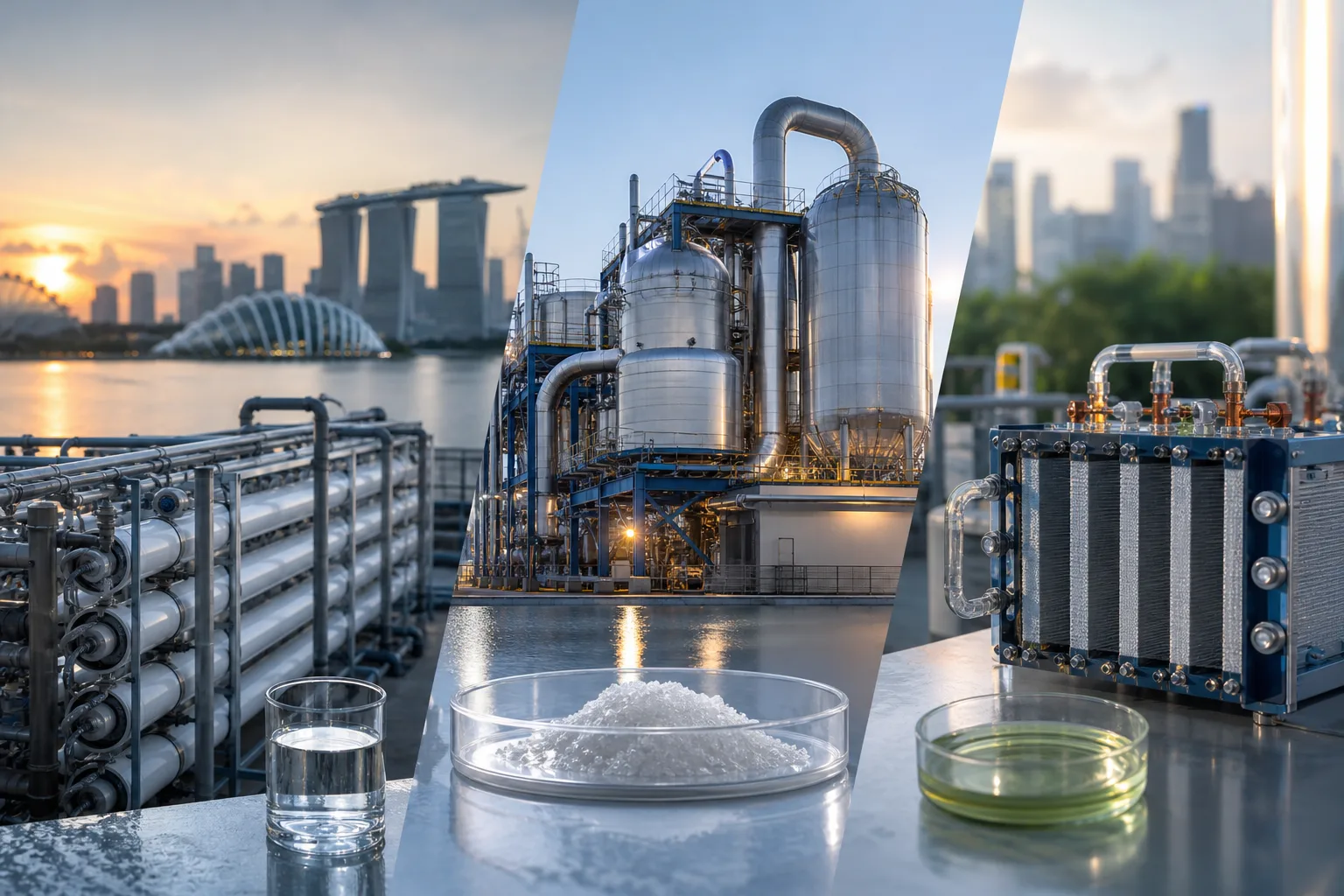
This article compares membrane concentration, thermal evaporation, and electro-membrane concentration to help you select the best brine treatment route based on recovery, energy, and reuse goals.
You’re reviewing yesterday’s desalination run when the recovered freshwater looks acceptable, but the remaining brine is harder to concentrate, reuse, or discharge. In Singapore, limited land, strict discharge expectations, humid operating conditions, and costly energy make each treatment step matter. The practical question behind brine concentration technologies is how to reduce that burden without creating another one through fouling, scaling, or rising thermal duty.
Most operators don’t have a brine volume problem. They have a treatment-sequence problem. The right route depends on your stream chemistry, discharge target, energy supply, and recovery priorities.
This comparison weighs membrane concentration, thermal evaporation and crystallization, and electro-membrane concentration against Singapore operating needs and resource recovery goals. MediSun Energy can connect Reverse Electrodialysis and CO₂ mineralization to a circular brine strategy, although the right fit still depends on your stream chemistry, discharge target, and recovery priorities.
You need more than a catalogue of equipment when your brine must meet a discharge limit, fit a tight site, and support resource recovery. The useful comparison asks what each route does to water recovery, energy demand, scaling risk, residual handling, and future reuse.
Apply the same questions to high-recovery membranes, thermal evaporation and crystallization, and electro-membrane concentration. Your stream chemistry and target endpoint decide the ranking.

Start with the operating case, not the technology name. Seawater reverse osmosis may concentrate salt to about 2 times its starting concentration, while multi-stage flash may reach about 1.5 times, according to Lenntech’s brine treatment guidance. These figures illustrate route differences, not guaranteed plant performance. Your salinity, temperature, antiscalant chemistry, and endpoint will change the result.
For your Singapore site, limited land, humid conditions, electricity costs, and strict discharge expectations make footprint and residual handling central. High-recovery membranes often reduce volume with lower heat demand. Thermal evaporation and crystallization suit a zero-liquid-discharge endpoint, but you must justify their heat, maintenance, and solids-handling burden. Electro-membrane concentration may fit when selective recovery matters more than simple volume reduction.
If you want more than disposal, specify the product before selecting the concentrator. Reverse Electrodialysis can support an energy-efficient circular solution, while CO₂ mineralization may convert suitable brine and industrial waste streams into useful mineral outputs. MediSun Energy can connect these routes, although feed chemistry and product quality still limit the fit.
Practical rule: Define your residual stream and desired outcome first, then compare each route against that operating case.
When you need to reduce brine volume before thermal treatment, high-recovery membrane concentration can remove water with lower energy demand. You first condition the feed, then use high-pressure reverse osmosis to recover more water and leave a smaller residual stream.
This route is a front-end step, not a complete zero-liquid-discharge solution. You must stop membrane recovery before scaling, fouling, rising osmotic pressure, and chemical cleaning make the next unit more costly than the volume saved.

Brine concentrate is the saltier reject stream left after water passes through a membrane. You may reuse the recovered water, while sending the concentrated residual to thermal treatment, discharge control, or resource recovery.
Brine is a type of salt water, but desalination brine is not ordinary seawater. You may find higher salinity, antiscalants, metals, or mixed industrial contaminants in it.
Use membrane concentration after pretreatment removes suspended solids and controls hardness and scale-forming species. You then recover relatively low-energy water first, leaving less volume for evaporation or crystallization.
The trade-off is chemistry control. You must track osmotic pressure, scaling risk, fouling, and cleaning requirements rather than treating high recovery as the only target.
Use it if your brine can be conditioned reliably and a smaller residual will make thermal treatment or resource recovery more practical.
When your permit or project brief allows no routine liquid discharge, thermal treatment takes the stream beyond ordinary volume reduction, recovering condensate while pushing the remaining liquor toward solid salts.
You need a staged system, not one oversized machine. The energy burden rises, but engineered treatment fits Singapore’s land constraints far better than evaporation ponds in a wet climate.

Zero liquid discharge means you produce no routine liquid discharge, although you still create solids that require testing, reuse, or disposal. A brine concentrator or evaporator first recovers clean distillate and reduces liquid volume. A crystallizer then boils the concentrated slurry into dry salts and additional distillate, as described by ScienceDirect.
Mechanical vapour compression can recycle latent heat. Veolia Water Technologies explains that falling-film evaporators boil and recompress vapour, helping concentrate high-salinity streams with improved thermal efficiency. You still need heat integration, corrosion control, and reliable solids handling.
You dispose of the final residue according to its chemistry, approvals, and possible reuse. First assess salt quality for recovery. If reuse is unsuitable, you arrange tested, compliant disposal of the mixed solids. Evaporation ponds are a weak fit for your Singapore site because land is scarce and rainfall complicates containment.
ZLD works best when you cannot accept a concentrated liquid outlet and your project can support thermal utilities.
Use it if your design objective is ZLD, your chemistry is well characterised, and your site can support thermal energy and approved solids management.
Could your brine become a feedstock, not only a disposal problem? Electro-membrane systems use electricity to move charged ions through selective membranes, giving you a different route from pressure-driven membranes and thermal evaporation.
You can use brine as an input for mineral recovery, chemical production, or industrial integration when its chemistry and market quality support those outcomes.
Reverse Electrodialysis can help you assess ion movement alongside water recovery. MediSun Energy pairs that pathway with CO₂ mineralization, although each stream still requires case-specific testing and process design.
You may recover water first, then evaluate salts and minerals for reuse. NEOM is exploring concentrations above 210 g/L for salt crystallization, according to Smart Water Magazine, but that is not a universal Singapore design target.
Choose this route when you want concentration linked to resource recovery, decarbonizing desalination, or industrial waste-stream integration.
Your trade-off is electricity demand, membrane selectivity, fouling risk, and uncertain product quality. Use it if your recovery ambition justifies testing the complete circular process.
Your best brine concentration train may combine routes rather than select one in isolation. In Singapore, you must weigh salinity, discharge targets, available heat, electricity supply, site limits, and resource-recovery goals together.
The table gives you one operator-facing view of concentration depth, operating burden, circularity, and qualitative cost. No universal Singapore price applies because energy integration and downstream treatment can change the design materially.
| option | best for | strength | limitation | cost |
|---|---|---|---|---|
| High-recovery membranes | First-stage brine volume reduction and water recovery | Generally lower energy burden than thermal treatment | Fouling, scaling and rising osmotic pressure limit recovery | Lower-energy front end; downstream treatment may still be required |
| Thermal evaporation and crystallization | Deep concentration and zero liquid discharge | Recovers condensate and converts final residuals to solids | Higher thermal duty, scaling risk and mixed-salt handling burden | Higher energy and equipment burden; heat integration can reduce demand |
| Electro-membrane concentration | Selective ion handling and resource-recovery integration | Can connect charged-species separation with circular outputs | Performance depends strongly on stream chemistry and process integration | Project-dependent; requires testing and integration assessment |
You will usually examine membranes first when lower energy demand and volume reduction matter. Thermal treatment suits your deepest concentration or zero liquid discharge target, while electro-membrane treatment deserves testing when selective ions and recovery outputs shape the project.
Weak train: You send raw brine directly to a crystallizer, accepting avoidable heat demand and fouling risk.
Stronger train: You use high-recovery membranes first, then thermal treatment for residual salts, with electro-membrane treatment tested where selective recovery adds value. Your flow, salinity, salt composition, discharge target, and available heat or electricity determine the final design.
When you label a stream as brine, you still need to identify its chemistry, origin, contaminants, and intended outcome before selecting concentration equipment.
Brine is a concentrated aqueous solution containing dissolved salts, usually produced as a reject or residual stream from desalination, industrial separation, or water treatment. You may also use brine where a saline medium is needed for industrial processing, heat transfer, preservation, or mineral handling. Its composition and contamination controls determine whether reuse is realistic.
Common names include saline solution, salt solution, concentrated saltwater, concentrate, and reject. You cannot treat these terms as exact equivalents: “reject” usually describes a treatment residual, while “concentrate” describes a stream made more concentrated. Check the process origin and laboratory results before you compare recovery or disposal options.
Water is usually the main component of brine by mass, while dissolved salts define its behaviour. You may find sodium chloride alongside calcium, magnesium, sulphate, bicarbonate, silica, metals, or treatment chemicals. That mixture affects scaling, fouling, recovery value, and the equipment suitable for your stream.
Brine is salty, but it is not necessarily only sodium chloride or safe for direct reuse. You need to distinguish salinity from contamination because industrial brine may contain organics, metals, or process residues. Characterise your stream in the laboratory before choosing resource recovery, concentration, discharge, or disposal equipment.
Zero liquid discharge (ZLD) is a treatment strategy that aims to recover usable water and leave no liquid effluent for discharge. A typical train combines membrane concentration with evaporation and crystallization, though the right sequence depends on the brine chemistry, energy supply, solids quality, and required endpoint.
Brine can support salt recovery, mineral extraction, dust control, de-icing, and selected industrial processes. Its value depends on purity, composition, and consistency. In some systems, Reverse Electrodialysis can help recover energy or concentrate ions, while CO₂ mineralization may turn suitable brine streams into useful mineral products.
Brine disposal may involve permitted discharge, deep-well injection, evaporation ponds, crystallization, or treatment for internal reuse. The suitable route depends on local permits, geology, climate, transport distance, and contaminants. Before choosing one, measure the stream across normal production, cleaning, rainfall, and maintenance conditions.
Brine concentrate is the saltier stream left after water has been removed from wastewater, seawater, or another saline feed. It contains a higher proportion of dissolved salts and may also contain hardness, metals, organics, or treatment chemicals. Characterization determines whether it suits recovery, further concentration, or regulated disposal.
A salt reading cannot describe your Singapore stream. You need operating data that shows what changes during production, cleaning, rainfall, and maintenance.
That evidence lets you choose a treatment train for the actual endpoint, not a catalogue assumption. Start small, then test the route that fits your chemistry and circular ambitions.
Build one characterization sheet for your real Singapore stream. Use it to frame a MediSun Energy integration discussion around data, pilot needs, and circular outputs, rather than a predetermined technology.
If you want a faster way to scope the right train, MediSun Energy assesses brine data, plans pilot requirements, and connects concentration with resource recovery for desalination operators and industrial manufacturers. Explore practical guidance on brine management and circular water solutions before an integration discussion.




