Physical Address
304 North Cardinal St.
Dorchester Center, MA 02124
Physical Address
304 North Cardinal St.
Dorchester Center, MA 02124

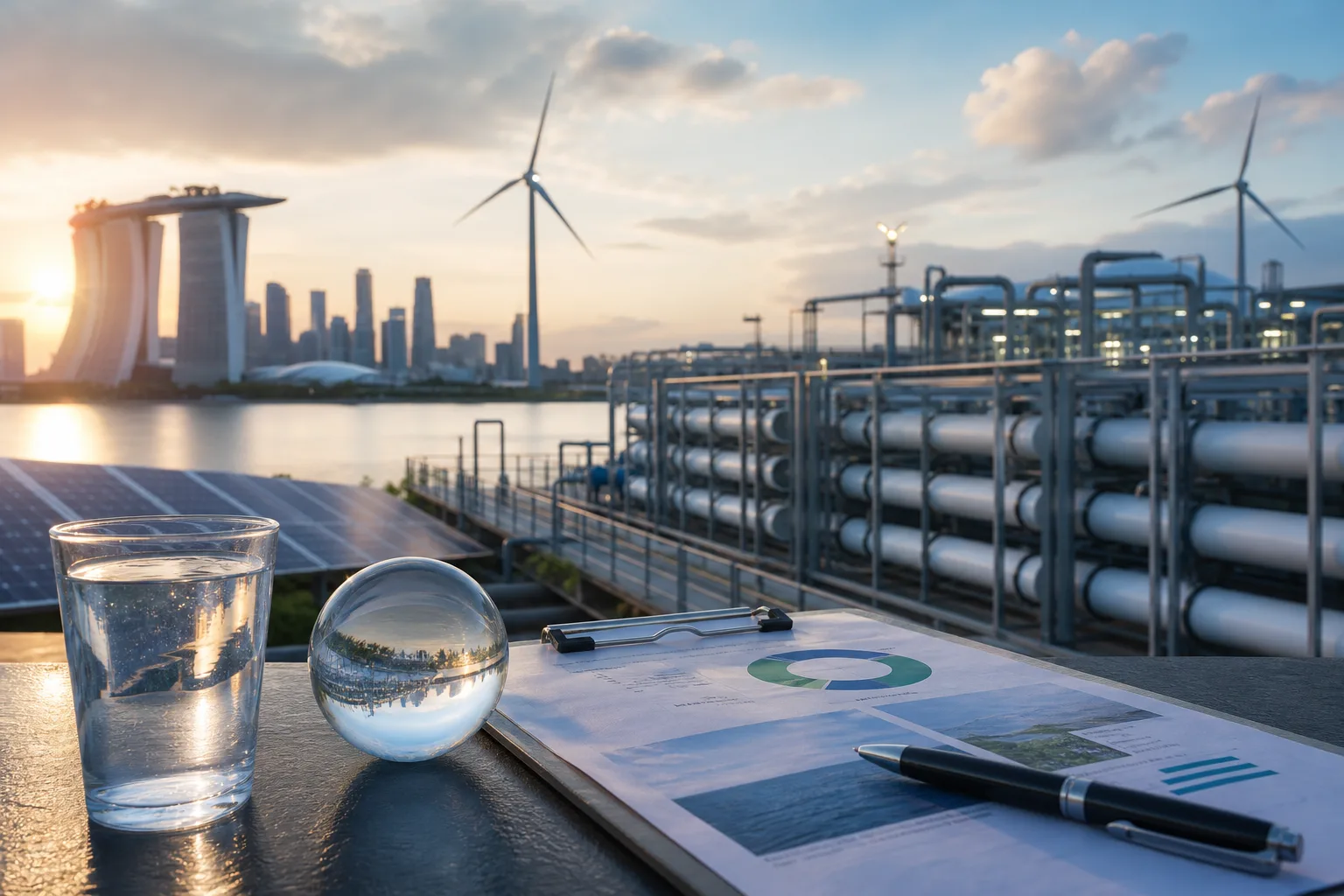
Explore how to create an evidence-ready approval case for low-carbon desalination by modeling energy use, brine treatment, and Singapore-dollar economics beyond just renewable power.
You are in a Singapore investment meeting with a desalination proposal that meets its water-quality specification. Yet approval stalls. Your committee still cannot see how electricity costs will behave, where concentrated brine will go, which emissions belong in the project boundary, or whether the financial model survives a difficult operating year. That is the challenge behind Building the Business Case for Low-Carbon Desalination. The technical design works. The approval case does not.
Most low-carbon desalination projects don’t have a technology problem. They have a business-case problem. You can see why desalination matters when freshwater is limited and most of Earth’s water is salt water, but a lower-carbon label alone won’t make your project investable. The case must prove the operating model, not simply identify a renewable power source.
This guide shows how to establish a baseline, quantify energy and carbon, treat brine as a process stream, test resilience, model Singapore-dollar economics, and assign evidence owners before approval. MediSun Energy approaches that work through integrated brine management, including Reverse Electrodialysis and CO₂ mineralization, although each site still requires technical and commercial validation. The result is an evidence-ready approval conversation, not a technology pitch.
You can secure dependable potable water and still present a weak investment case. If your model isolates renewable electricity, it may miss operating-budget volatility, brine obligations, maintenance exposure, and the evidence required for ESG and permitting confidence.
Desalinated water has clear value for Singapore’s supply resilience, but that value depends on cost, continuity, and a credible plan for concentrated brine. Your approval case must connect water output with the full operating model, not just a lower-carbon power source.

Desalinated water can provide a dependable potable supply when you need greater source diversity and predictable quality. You can also reduce exposure to rainfall variability, but your benefit case must state the contracted duty, reliability target, quality specification, and value in Singapore dollars per cubic metre.
Energy remains central. The Saudi Water Authority reports that energy may represent 30% to over 50% of total water production costs in desalination. Its 2025 report provides that benchmark.
“Energy represents 30% to over 50% of total water production costs,” according to the Saudi Water Authority’s 2025 report.
The biggest problem is not only electricity demand. You must also fund pretreatment, chemicals, membrane replacement, monitoring, intake systems, and concentrated brine management. Brine is an operating and permitting obligation, not simply a disposal line.
MediSun Energy addresses this gap through integrated brine management, including Reverse Electrodialysis and CO₂ mineralization, although each site still requires technical validation and a proven commercial pathway. Resource recovery may improve the case, but it cannot replace a properly costed baseline.
Practical rule: Treat renewable power as one sensitivity in your Singapore-dollar model, never as the complete low-carbon business case.
No single headline figure is reliable for your project. Total cost changes with capacity, intake and outfall, pretreatment, land, grid connection, storage, financing, integration, and the delivery model. A historical example shows the scale of capital-market variation: the University of Surrey records Modern Water plc raising £30m cash at its 2007 AIM flotation. The University of Surrey case study reports that transaction.
| priority | what to check | why |
|---|---|---|
| Energy exposure | Model electricity as 30% to over 50% of total water production cost, then test Singapore electricity-price scenarios | Energy volatility can dominate operating budgets and undermine the business case |
| Water value | Define potable-water duty, quality requirements, reliability and contracted offtake in Singapore dollars per cubic metre | A lower-carbon process still needs a clear revenue or avoided-cost pathway |
| Brine pathway | Cost intake, concentration, treatment, monitoring, discharge or recovery from the baseline onward | Brine is an operating and permitting obligation, not merely a disposal line |
| Capital and finance | Separate equipment, civil works, integration, contingency, financing and replacement costs | Plant cost varies materially with site, scale, interfaces and delivery structure |
You need one functional unit before comparing technologies: Singapore dollars per cubic metre of delivered water across the project life. Every option must use the same system boundary, including intake, treatment, energy, chemicals, maintenance, membranes, brine handling, financing, and offtake.

Your baseline should describe the existing or proposed seawater reverse osmosis plant, not an idealised competitor case. You then compare energy demand, carbon intensity, recovered water, brine volume, resource value, and lifecycle cost on that same basis.
You will typically assemble an EPC contractor, membrane and process supplier, intake and outfall specialists, and an integration partner. Your model should assign each party a defined scope, interface, performance guarantee, and replacement obligation rather than treating the plant as one supplier’s product.
Weak model: “Harbour East SWRO, low-carbon package, S$ per cubic metre.”
Strong model: “Harbour East SWRO, delivered-water cost in S$ per cubic metre, including intake, electricity, chemicals, membrane replacement, brine treatment, monitoring, and verified offtake.”
Reverse osmosis produces concentrated brine, which you must discharge, treat, monitor, or recover under a defined mass balance. MediSun Energy can complement SWRO through Reverse Electrodialysis for energy-efficient brine management and CO₂ mineralization for industrial waste streams, but you need site testing, controls, product verification, and a buyer for any recovered material.
Operating plants in Gibraltar and Oman reportedly use 30% less energy than conventional desalination plants, according to the University of Surrey. A forward osmosis process in Oman reportedly used 42% less energy per litre under poor feedwater conditions, also according to the University of Surrey. Those figures are project evidence, not a guaranteed Singapore result.
Your answer comes from the contracted daily output, recovery rate, feedwater quality, maintenance plan, and availability assumption. Record water production and brine volume together, because a higher recovery claim can change both energy demand and disposal obligations.
The chart compares the reported energy reductions: operating plants in Gibraltar and Oman show 30%, while forward osmosis in Oman under poor feedwater conditions shows 42%. Your Singapore validation should test those outcomes against local feedwater, controls, integration limits, and actual electricity conditions.
| priority | what to check | why |
|---|---|---|
| Functional unit | Use Singapore dollars per cubic metre of delivered water over the full lifecycle | A common unit prevents incompatible technology and cost comparisons |
| Baseline SWRO | Record feedwater, recovery, electricity, chemicals, membrane replacement, water output and brine volume | The existing or proposed reference case determines whether an improvement is real |
| Energy evidence | Use the reported 30% lower energy in Gibraltar and Oman and 42% lower energy per litre in Oman as case evidence, then validate locally | Performance depends on feedwater, operating conditions and process design |
| Resource pathway | Map brine composition, Reverse Electrodialysis interfaces, CO₂ source, mineralization product and offtake | Resource recovery only creates value when streams, controls, products and buyers are specified |
Your investment committee needs more than a base-case return. It needs to see whether a conventional SWRO project and an integrated circular model still work when electricity prices, feedwater quality, construction timing, carbon assumptions, brine obligations, and financing terms change.

You should model both options in Singapore dollars per cubic metre of delivered water, then test each assumption independently. Integration may reduce energy exposure and create resource value, but it also adds interfaces, controls, verification, contracting, and commissioning risk.
The supplied evidence does not establish which country gets 97% of its drinking water through desalination, so you should not use that figure in an approval paper. The University of Surrey reports research focused on combining osmosis processes with renewable sources such as solar thermal, supporting combined energy analysis rather than a guaranteed financial outcome.
There is no single construction duration you can apply safely to every desalination plant. You should stage the Singapore plan through feasibility, pilot work, front-end engineering, permitting, procurement, construction, commissioning, and ramp-up, with delay scenarios built into financing and offtake assumptions.
Weak case: “SWRO delivery, fixed electricity cost, and brine disposal treated as a zero-cost line.”
Integrated case: “Singapore SWRO with Reverse Electrodialysis, CO₂ mineralization, measured brine handling, and contracted resource offtake.”
The supplied evidence does not identify that country or verify a largest-plant record, so you should leave the claim out of the committee model. Scale changes risk: a larger facility may improve unit economics, while it can increase permitting exposure, interface count, commissioning complexity, and the cost of delay.
Your stress-test chart gives equal attention, with a value of 1 each, to six variables: electricity exposure, feedwater and recovery, construction delay, carbon uncertainty, brine and offtake risk, and financing sensitivity. MediSun Energy can address the circular pathway, although you still need independent performance evidence and bankable contracts before approval.
You can make a low-carbon desalination proposal look attractive by changing the baseline, narrowing the carbon boundary, or treating uncertain revenue as guaranteed. That does not make your investment case stronger. It makes the downside harder to see.
Each benefit needs evidence, an owner, and a failure scenario. These are the points where persuasive proposals commonly lose credibility.
| situation | better move | why |
|---|---|---|
| A proposal compares a new process with a generic conventional plant | Set one Singapore site, water duty, functional unit and lifecycle boundary before comparing options | Without a common baseline, percentage improvements and costs can be overstated |
| Renewable electricity is counted as zero-risk operating power | Model intermittency, storage, grid backup, curtailment and electricity-price scenarios | Installed renewable capacity does not guarantee continuous desalination output |
| Brine appears as a single disposal cost | Characterize the stream and test discharge, concentration, recovery and offtake pathways | Brine chemistry affects permitting, energy, equipment and potential resource value |
| Carbon savings are reported without a boundary | State the counterfactual, electricity factor, construction boundary, chemicals, transport and verification method | A narrow boundary can make savings look larger than the project-wide result |
| MediSun Energy integration is treated as plug-and-play | Validate Reverse Electrodialysis and CO₂ mineralization with site-specific pilots, controls, product testing and offtake evidence | Circular integration may add value but also adds interfaces and delivery risk |

You need to separate renewable generation from dependable process energy. Your model should show storage losses, grid backup, curtailment, demand charges, and the electricity price used during shortfalls. Otherwise, you compare installed capacity with actual water delivery.
You can also mistake operating history for transferable proof. The University of Surrey reported that 2 Oman plants using Manipulated Osmosis had operated since 2009 without membrane cleaning, but you still need Singapore-specific feedwater, fouling, controls, and maintenance evidence. The University of Surrey also reported £249,000 in Royal Society innovation funding, which shows staged development support, not commercial viability.
You should treat brine as a process stream with chemistry, volume, contaminants, and possible value. MediSun Energy’s Reverse Electrodialysis and CO₂ mineralization may support resource recovery, but you need mass balances, energy measurements, contaminant testing, product specifications, and monitoring and verification for your site.
You cannot claim carbon savings until you define the counterfactual, system boundary, grid factor, construction impacts, chemicals, transport, and verification method. You also need an owner and contract for every proposed product or resilience benefit.
Desalination gives coastal communities a dependable water source when rainfall, rivers, or aquifers cannot meet demand. It can support drought planning, industrial production, and population growth without drawing more freshwater from stressed basins. Its value depends on the electricity source, plant efficiency, intake design, and brine management, so a low-carbon project must measure the full system.
Plant delivery is usually split among technology suppliers, engineering and construction firms, equipment manufacturers, and operators. Companies such as Veolia, SUEZ, IDE Technologies, and Acciona have delivered desalination projects in different markets. The right partner depends on plant size, feedwater, financing model, local regulations, and whether the project needs resource recovery or decarbonizing desalination.
The central challenge is managing energy demand and concentrated brine without shifting environmental harm elsewhere. Poorly designed intakes can affect marine life, while poorly controlled discharge can alter local salinity. Electricity prices also shape operating costs and emissions. A sound case therefore measures water output, power use, carbon, brine composition, discharge conditions, and monitoring requirements together.
No single price applies to every desalination plant. Capital cost changes with capacity, feedwater quality, pretreatment, intake and outfall works, land, energy recovery, storage, financing, and local construction conditions. For approval, build a Singapore-dollar estimate with separate capital and operating costs, then test electricity prices, schedule delays, financing rates, and output shortfalls instead of relying on a headline figure.
Your approval case becomes usable when every major assumption fits on one page. You can then show what the Singapore site produces, consumes, discharges, and risks before discussing any technology partner.
Separate demonstrated operating scale from project ambition. The University of Surrey reports desalination plants serving 600 people in Al-Khuluf and 800 people in Naghdah, Oman. Its Centre for Osmosis Research & Applications was founded in 2003, but you still need current site evidence for your project.
If you want a faster way to build the case, MediSun Energy supports plant operators, manufacturers, engineering firms, and public-sector sponsors with brine management, Reverse Electrodialysis, and CO₂ mineralization. Its practical guidance on circular desalination and resource recovery can inform your next evidence review.