Physical Address
304 North Cardinal St.
Dorchester Center, MA 02124
Physical Address
304 North Cardinal St.
Dorchester Center, MA 02124

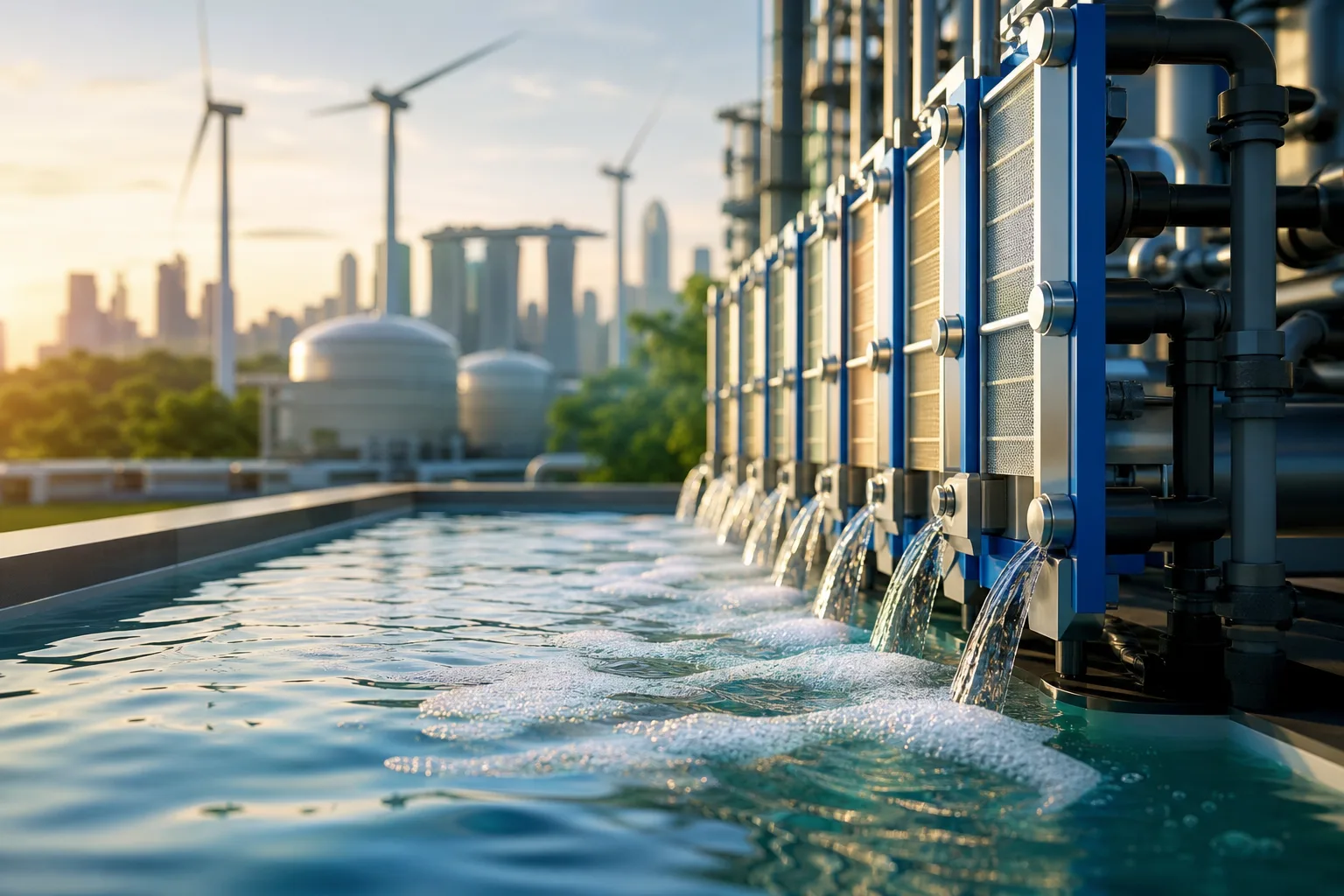
Discover how reverse electrodialysis converts salt concentration differences into usable power, optimizing brine disposal and resource recovery with practical site integration.
At the end of a desalination shift, you still have concentrated brine moving toward storage, discharge, or further treatment. You must account for pumping demand, compliance exposure, disposal cost, and the carbon tied to each option. Yet the difference between that brine and a lower-salinity stream still contains usable chemical energy. This is the premise behind Reverse Electrodialysis Explained: Power from Salt Gradients.
Most desalination operators don’t have only a brine-disposal problem. They have a resource-recovery problem. ScienceDirect describes Reverse Electrodialysis as a membrane-based method that generates renewable energy while two solutions with different salinities mix. The process starts with streams already moving through your site.
You need to know how to pair feed streams, how alternating membranes and stacks turn ion movement into voltage, what electrical output you can realistically expect, and where integration becomes uneconomic. MediSun Energy applies this circular brine-management perspective, although RED isn’t a universal disposal replacement and very high salinity can reduce efficiency. The result is a practical screening framework for your Singapore project, not a technology sales pitch.
Which two water streams can you safely place on opposite sides of a Reverse Electrodialysis system? You need one high-salinity feed, one compatible lower-salinity feed, and enough flow from both to maintain the gradient.
Possible pairings include seawater with freshwater, brackish water with desalination brine, or desalination concentrate with a dilute process stream. Solar-pond brine is also a researched feed example, but that pairing remains site-specific rather than a guaranteed plant configuration. A 2022 review published by ScienceDirect reports that RED generally operates more efficiently with seawater and freshwater than with very concentrated brine, where efficiency can fall.
Your screening decision must cover chemistry, timing, temperature, pressure, and flow before any stack design. Realistic brines may contain sodium, magnesium, calcium, chloride, sulphate, and bicarbonate. Those ions affect membrane compatibility, scaling risk, pretreatment, and electrical performance.

RED suits a site with two measured streams that can meet continuously, not merely two streams that look different on a laboratory report. A weak pairing assumes that “brine plus freshwater” is sufficient. A stronger pairing records 80 m3/h of desalination concentrate, 25°C inlet temperature, and a matching dilute process stream with stable daily availability.
Strong screening example: Pair a measured desalination concentrate with a compatible dilute industrial stream after checking scaling ions, organics, and biological activity. Then confirm both streams can reach the stack at suitable pressure and flow.
Practical rule: Do not approve a RED feed pairing until measured salinity, chemistry, temperature, pressure, and coincident flow data support it.
The trade-off is clear: concentrated brine may offer a stronger gradient but create greater scaling, fouling, and membrane-compatibility demands. You may need filtration, antiscalant control, biological management, or dilution, which can reduce the net energy benefit.
Use RED when your site can match a high-salinity stream with a stable, compatible dilute stream and verify the pairing through measured data.
Inside a Reverse Electrodialysis stack, ion-selective membranes direct charged ions through separate channels while pumps keep the two water streams apart. The brine stream does not simply mix with the lower-salinity stream.
ScienceDirect’s 2022 review describes RED as alternating anion- and cation-exchange membranes positioned between two electrodes. In practice, membrane selectivity, channel spacing, flow velocity, and concentration polarisation determine whether your stack produces useful power.
A typical stack repeats this sequence: high-salinity channel, cation-exchange membrane, low-salinity channel, anion-exchange membrane, then another high-salinity channel. A CEM preferentially passes positively charged ions such as sodium, while an AEM preferentially passes negatively charged ions such as chloride. Other ions may also move, because neither membrane is perfectly selective.
Ions move from higher concentration toward lower concentration across suitable membranes. Each membrane pair contributes electrochemical potential, so repeated pairs build the stack’s voltage. The electrodes collect the resulting current. Pumps maintain separate flow paths rather than allowing uncontrolled bulk mixing.
Weak configuration: A Jurong brine pilot uses narrow channels and high pump speed without checking pressure drop, residence time, or concentration polarisation.
Strong configuration: A Jurong brine pilot sets channel spacing and flow velocity from measured salinity, temperature, membrane selectivity, and allowable pressure drop, then verifies output under matched operating conditions.
The trade-off is that stronger gradients can increase output while also intensifying scaling, fouling, and concentration polarisation. Higher flow may reduce boundary-layer effects, but it can raise pumping energy and pressure drop. Use RED when your measured streams support stable channel operation and the net electrical gain remains positive after pretreatment and pumping.
At the stack electrodes, ion flux drives water splitting or reversible redox reactions, converting the membrane-separated chemical gradient into current. You then need power conditioning before that output can serve pumps, controls, or export equipment.
Reported freshwater-seawater systems produce membrane-area power densities of 0.33–3.8 W/m², according to ScienceDirect’s 2022 review. That is a literature range, not a Singapore project guarantee. Your usable output falls after membrane resistance, electrode overpotentials, pumping energy, fouling, and concentration polarisation are included.
RED fits a measured, continuous salinity gradient where you can recover value from brine while minimising extra electrical demand. A weak brief says, “Install RED beside the brine outlet.” A strong brief says, “Model a 1.1 cm/s channel, 24-hour brine flow, pretreatment load, and net export in SGD.” ScienceDirect reports channel velocities from 0.56 to 4.2 cm/s, while raising velocity from 0.7 to 1.1 cm/s increased open-circuit voltage by 35% and power density by 47%. Faster flow can help, but it also increases pumping demand.
The trade-off is scale and balance. A historical 50 kW Afsluitdijk pilot tested in 2014 shows scale-up evidence, according to ScienceDirect, but it does not prove universal commercial fit in 2026. MediSun Energy can assess integrated brine systems, although site chemistry and fouling still constrain performance.
Use RED when your site-specific SGD model shows stable net generation after pumping, pretreatment, and maintenance allowances.
If you are assessing desalination brine, the terminology can obscure the practical question: what enters the stack, what moves through the membranes, and what leaves as electricity? Direct answers connect the system components to feasibility work, so you can judge whether your streams offer useful net power rather than assume that any salty water pair will perform well.
Reverse electrodialysis generates power by moving ions from a concentrated stream toward a dilute stream through alternating selective membranes, creating a voltage across the stack. At the electrodes, that ion flux becomes electric current through water splitting or a reversible redox reaction, as reported by ScienceDirect. The result depends on salinity ratio, chemistry, flow, resistance, fouling, and pumping demand.
Reverse electrodialysis is a membrane-based technology that converts a salinity difference into electrical potential. You place alternating anion-exchange membranes and cation-exchange membranes between two electrodes, then circulate high- and low-salinity streams through separate channels. The stack captures part of the chemical energy released as ions move down the concentration gradient, without allowing the bulk streams to mix directly.
A reverse electrodialysis membrane controls which charged particles can cross it: cation-exchange membranes favour positively charged ions, while anion-exchange membranes favour negatively charged ions. Repeating these membrane pairs builds stack voltage as each channel contributes to the potential difference. Feed channels limit bulk mixing, but you still need to assess fouling, hydraulic resistance, chemistry, and pumping energy in the feasibility workflow.
Your next decision does not require a full plant design. You need enough measured evidence to show whether your brine and dilute stream can support Reverse Electrodialysis without creating a new pumping, fouling, or discharge problem.
A useful feasibility brief turns two water streams into a decision path. Start with one page, use measured Singapore operating data, and test net value rather than gross voltage alone.
A 2022 review published by ScienceDirect found that practical RED applications have faced limited success because of four key constraints: electrode overpotentials, ohmic resistance, pumping energy, and biofouling.
If you want a faster way to do this, MediSun Energy assesses brine chemistry, screens RED integration options, and frames resource recovery opportunities for desalination operators, industrial manufacturers, engineering firms, and public infrastructure teams through its technical articles on circular brine management.




