Physical Address
304 North Cardinal St.
Dorchester Center, MA 02124
Physical Address
304 North Cardinal St.
Dorchester Center, MA 02124

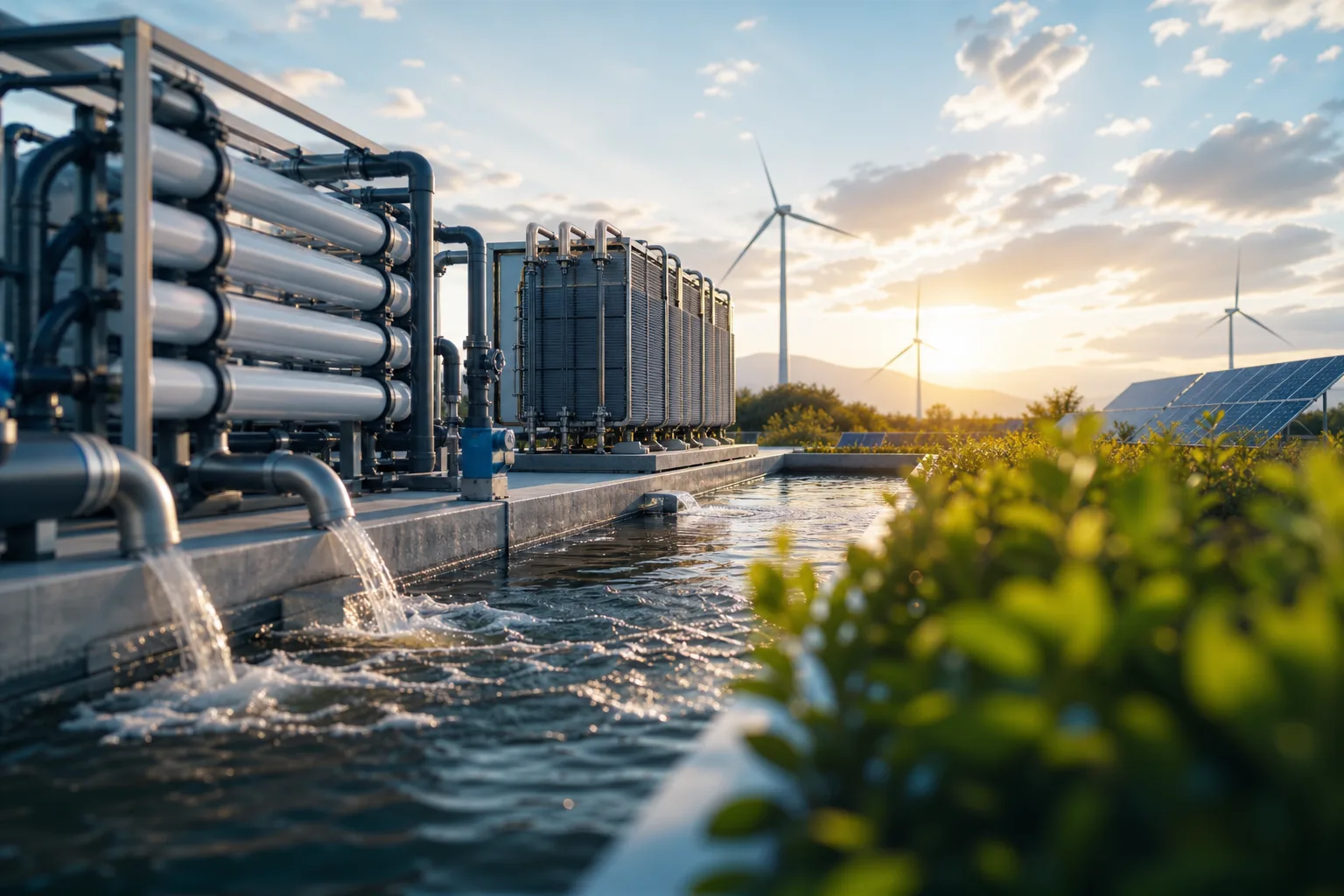
Discover how integrating Reverse Electrodialysis with seawater reverse osmosis enhances energy recovery, optimizes brine handling, and supports credible net-zero desalination.
At the morning operations meeting, you see the same pressure building: SWRO electricity demand is rising, concentrated brine still needs a responsible outlet, and a renewable power contract alone won’t prove a credible net-zero pathway. The case for Pairing Reverse Electrodialysis with Desalination for Net-Zero Plants starts here. Your plant may reduce grid emissions while leaving brine management, material use, and process integration unresolved.
Most desalination plants don’t have only an electricity problem. They have a system-design problem. Research published by ScienceDirect presents pairing Reverse Electrodialysis with SWRO as a way to recover energy from salinity gradients and support lower-carbon water production. MDPI likewise describes salinity-gradient energy harvesting through Reverse Electrodialysis as a promising route for decarbonizing desalination.
For a Singapore project, the practical test covers plant-boundary accounting, stream compatibility, fouling control, and pilot design. MediSun Energy connects brine management with industrial waste recovery and CO₂ mineralization. The goal isn’t another renewable-power claim. It’s a defensible integration case for your plant.
If you buy cleaner electricity for SWRO while treating brine discharge as a separate obligation, your carbon case remains incomplete. You may reduce imported power emissions yet miss energy recovery, pumping loads, chemical use, and the cost of moving concentrated brine through the plant.
For your Singapore operation, the stronger question isn’t whether RED produces useful energy alone. It’s whether SWRO, brine handling, electricity procurement, and resource recovery perform better as one measured system.

When you assess each workstream separately, you can overstate savings and underprice constraints. A RED installation may generate energy, while pretreatment, pumps, membrane resistance, cleaning, and brine transfer consume part of that gain. MediSun Energy links these decisions through brine management and resource recovery, although site-specific chemistry still limits where its approach fits.
The two primary desalination categories are thermal methods such as multistage flash distillation and membrane methods such as reverse osmosis, according to Energy Intelligence. For your plant, that distinction matters because SWRO creates a salinity-gradient stream suited to RED integration, while thermal systems follow a different energy pathway.
Research indicates that integrating RED with desalination could offset grid electricity by approximately 0.28 to 0.58 kWh/m³, according to MDPI’s 2020 study. That’s a research estimate, not a guaranteed Singapore project result. Your measured salinity, flow, temperature, membrane resistance, pretreatment, pumping loads, and selected electricity emissions factor will determine actual performance.
“Integrating RED helps offset grid-electricity consumption and mitigate indirect carbon emissions,” according to MDPI’s 2020 research.
The same study estimates potential global reductions of up to 1.18 Mt CO₂-equivalent annually, according to MDPI. Treat that figure as an indicator of system potential, not as a claim for your plant.
Your carbon boundary must include SWRO, RED, pumps, pretreatment, chemicals, brine handling, and grid imports. Account for the whole plant, not RED output alone. This gives you a defensible basis for comparing energy savings, carbon reductions, operating cost, and resource recovery.
Practical rule: Count every energy and material input from seawater intake to treated water delivery and final brine handling before claiming net-zero performance.
You start with seawater intake, screening, and pretreatment before a seawater reverse osmosis (SWRO) unit applies pressure across membranes. Freshwater leaves as product water, while the separated salts remain in a concentrated reject-brine stream. That brine isn’t waste at this stage. It’s the high-salinity side of a potential energy-recovery step.
You then pair the brine with a compatible lower-salinity stream, such as treated process water, and send both through a reverse electrodialysis (RED) stack. The combined process works only when stream chemistry, flow balance, membrane compatibility, and final brine management are designed together.

SWRO creates the salinity difference that RED uses. RED doesn’t replace SWRO, because it recovers energy from mixing solutions with different salt concentrations rather than removing salt from the original ocean feed. A 2020 ScienceDirect review describes salinity-gradient energy capture by RED as an emerging route for reducing reliance on conventional water-intensive energy systems.
Yes, you can desalinate ocean water with reverse osmosis, but the process needs high pressure and still produces concentrated brine. Desalination is the broader removal of salts, while reverse osmosis is one pressure-driven method within it.
Inside the RED stack, alternating anion-exchange membranes and cation-exchange membranes let different ions move selectively between the high- and low-salinity channels. ScienceDirect explains that this arrangement creates an electrochemical potential capable of producing usable electric power. MediSun Energy applies this principle to brine management, although RED performance remains dependent on feed quality and membrane fouling control.
Electrodialysis uses an electric field to move ions through selective membranes. RED reverses the operating logic: your salinity gradient drives ion movement, and the resulting potential generates electricity rather than directly desalinating the ocean feed.
No. Desalination describes the outcome, reverse osmosis describes one process, and electrodialysis describes an electrically driven ion-separation family. Your integrated plant must therefore treat SWRO, RED, and final brine handling as connected stages, not interchangeable technologies.
You can produce electricity from brine and still miss your plant’s low-carbon target. The failure usually appears in the design basis, the auxiliary load, or the discharge plan, not in the RED stack alone.
Your net-zero claim must survive operating data, maintenance conditions, and lifecycle accounting. A staged assessment exposes weak assumptions before you commit capital.

The first mistake is sizing RED from headline seawater salinity instead of your actual streams. Your design basis should include measured flow, concentration, temperature, seasonal variation, and available dilution water.
Gross RED generation isn’t your plant’s net energy benefit. You must subtract intake, pumping, pretreatment, RED circulation, controls, cleaning, and brine-management loads.
Fouling, scaling, organics, and weak pretreatment cause declining output and rising pressure drop. Energy recovery also leaves discharge quality, toxicity, permits, and cumulative brine impacts unresolved.
The biggest problem is a combined energy, brine, and lifecycle-accounting challenge, not one defective technology. MediSun Energy can assess your desalination brine and industrial waste streams for resource recovery and CO₂ mineralization opportunities, although site chemistry and permitting still limit which circular solutions will work.
Simple desalination questions still require careful answers. For your Singapore project, the useful answer must separate public claims from verified plant data, then connect water quality, brine handling, Reverse Electrodialysis, and whole-boundary carbon accounting.
You can’t responsibly name a country from that claim alone. You need a verified country, date, and authoritative source, because desalination may supply most of a nation’s drinking water without supplying most of its total water demand. For your plant, test the claim against local water balances, RED integration, and Singapore’s approved operating requirements.
Yes, reverse osmosis is widely used to desalinate seawater and brackish water. You still need to confirm feedwater quality, pretreatment, recovery, energy demand, concentrate management, and product-water specifications. Pairing SWRO with RED may improve the plant boundary, but your pilot must validate chemistry, output stability, auxiliary loads, and carbon performance under Singapore conditions.
You shouldn’t accept a fixed answer without checking current capacity and operating status. The result changes depending on whether you mean one site, installed capacity, or actual production capacity. For your comparison, use the same boundary and definition applied to the proposed plant, including RED equipment, brine systems, standby assets, and whole-site carbon accounting.
You may avoid RO water because of its mineral content, taste, source quality, or concerns about inadequate remineralization. Properly treated and regulated RO product water isn’t inherently unsafe. Your plant must verify post-treatment quality, monitoring, and distribution controls, while RED integration addresses brine and energy questions rather than replacing product-water validation.
Your next decision needs more than a promising RED output or a cleaner electricity contract. You need a plant boundary that captures every material flow, energy input, brine route, and recovered resource.
Start small, but start with measured plant data. A disciplined baseline lets you test whether Reverse Electrodialysis, brine management, and CO₂ mineralization belong in one credible low-carbon design.
For your Singapore project, put the entire system on one page before choosing equipment. Include SWRO intake and product water, RED equipment, pumps, pretreatment, chemicals, cleaning, brine treatment, grid electricity, and recovered resources.
Sample high- and low-salinity streams across operating conditions, not from one laboratory bottle. Model gross and net energy, emissions, avoided grid electricity, brine volumes, operating cost, and carbon benefits with assumptions your engineering team can audit.
Set acceptance criteria before selecting an integration pathway. Your pilot gates should cover the following:
That first page gives MediSun Energy the basis to assess RED, brine management, and CO₂ mineralization together. The defensible pathway is the one that survives measured constraints, not the one with the best isolated result.
If you want a faster way to do this, MediSun Energy assesses brine streams, RED integration, and CO₂ mineralization for desalination operators, industrial manufacturers, engineering firms, and public-sector project teams. You can find practical guidance in MediSun Energy’s technology and project articles.




