Physical Address
304 North Cardinal St.
Dorchester Center, MA 02124
Physical Address
304 North Cardinal St.
Dorchester Center, MA 02124

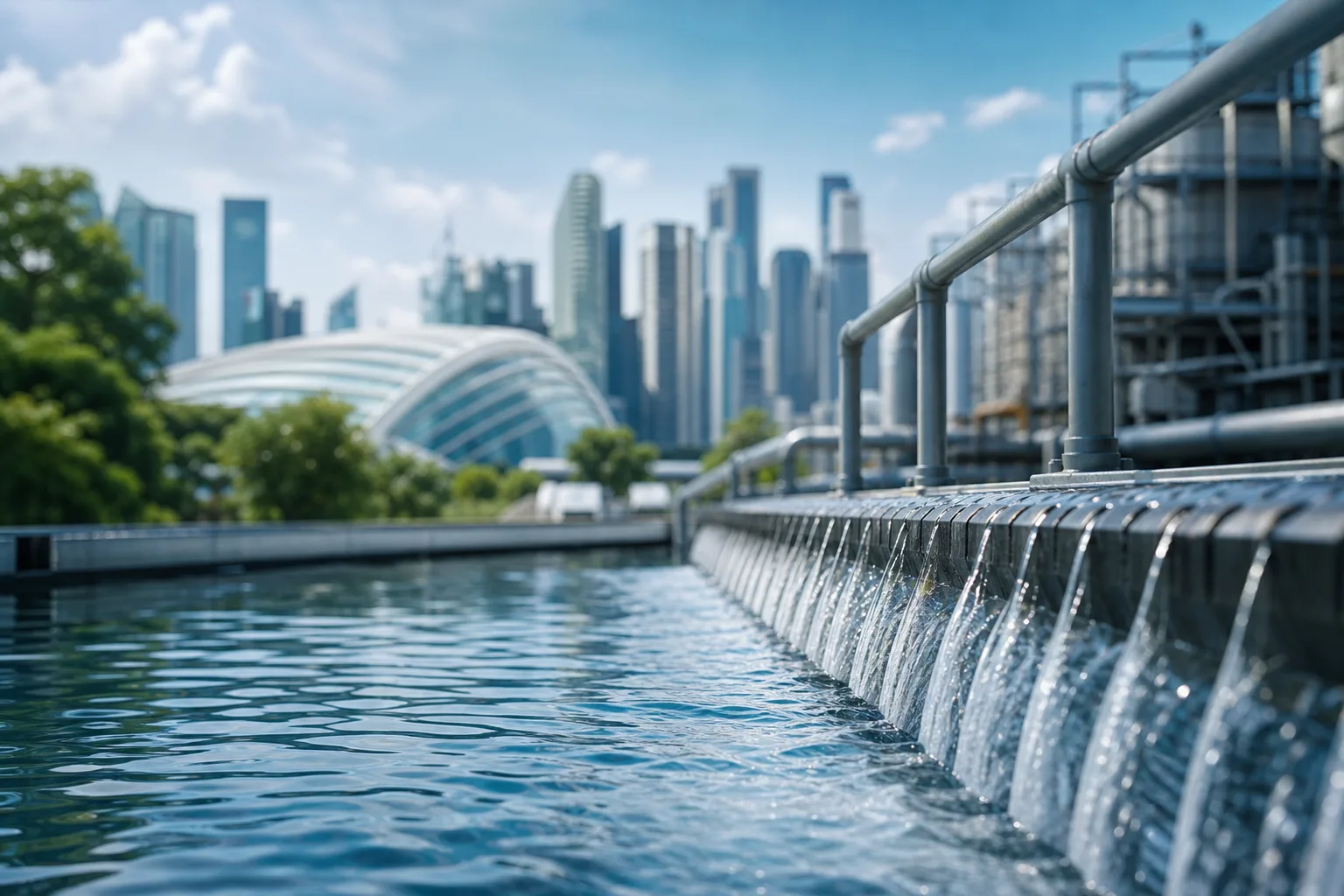
Explore how Singapore’s NEWater system transforms wastewater into ultra-clean water for industrial and indirect potable use, closing the water loop efficiently.
You are reviewing a plant’s water balance when the contradiction becomes hard to ignore. Singapore has limited natural water resources, yet your factory needs tighter water quality control, while desalination leaves concentrated brine that still requires a responsible destination. That is where NEWater and the Circular Water Economy meet. The Centre for Liveable Cities describes NEWater as ultra-clean recycled wastewater made from domestic and industrial wastewater, while PUB identifies it as Singapore’s Third National Tap.
The useful question is how collection, reclamation, advanced treatment, reservoirs, industrial demand, energy, and residual streams connect. The loop runs from used water to industrial supply and indirect potable use, then leads to a separate design challenge: industrial resource recovery. MediSun Energy fits that gap with Reverse Electrodialysis and CO₂ mineralization. Those technologies address brine and waste streams rather than replacing NEWater’s public-water role. Singapore shows what an integrated system can achieve, while low-carbon circular infrastructure still has to redesign how it handles residuals.
For you, the risk is not simply running short of water. Your factory can lose production when feedwater quality shifts, while your public utility faces greater pressure when dry weather reduces conventional supplies. NEWater gives Singapore another way to use the same finite resource, but its value depends on where you send that water and what quality its destination requires.
The Centre for Liveable Cities explains that water recycling creates a multiplier effect for Singapore’s limited water resources. You can treat circular water as a managed loop, not a one-time treatment step. The right question is not whether a stream began as wastewater. It’s whether its chemistry, risk, energy demand, recovery potential, and final use make the loop worthwhile.

You can strengthen resilience when you collect water, treat it, and return it to productive use instead of ending at discharge. The Centre for Liveable Cities reports that NEWater supports repeated reuse of Singapore’s water resources and helps protect supply against climate risks through reservoir top-up. Your recovery plan builds resilience when it works across changing weather conditions, not only when one source performs well.
Your industrial customer may need exceptionally consistent, high-purity water, while your public system may use NEWater to top up impounding reservoirs for indirect potable use. Those are different operating pathways. Potable safety does not automatically mean direct household distribution. In Singapore, reservoir water still follows a managed treatment pathway before entering the drinking-water system.
NEWater is designed to be potable, although most of it is sold to industrial customers that require high-purity water, according to the Centre for Liveable Cities.
That distinction changes your planning brief. If you’re planning for a semiconductor facility, a reservoir, or a cooling system, you’ll need different quality controls, monitoring, storage, and energy decisions for each. Treating those uses as interchangeable can raise your costs without improving resilience.
Apply the same test to desalination brine and industrial waste streams. MediSun Energy uses Reverse Electrodialysis and CO₂ mineralization to pursue resource recovery, although those technologies do not replace NEWater’s public-water role. You’ll find value only when the stream’s composition, the energy required, and the usefulness of the recovered product justify the loop.
Practical rule: Judge circular water by the whole loop and its end use, not by the source label alone.
When you trace Singapore’s water system, the loop begins before purification. Used water travels through the Deep Tunnel Sewerage System by gravity to water reclamation plants. PUB describes tunnels up to 6 metres in diameter and as deep as 55 metres underground, connecting collection with treatment at national scale.
That is why NEWater is more than wastewater treatment. Collection, purification, end-use planning, reservoir management, sludge recovery, and public confidence all determine whether used water becomes strategic supply.

At the reclamation plant, treated used water passes through three main NEWater processes identified by PUB: microfiltration, reverse osmosis, and ultraviolet disinfection. Microfiltration removes suspended solids and microorganisms, reverse osmosis removes dissolved contaminants, and ultraviolet treatment provides a final disinfection barrier.
PUB commissioned a full-scale demonstration plant in 2000 that could produce 10,000 cubic metres a day. That milestone shows why collection infrastructure and membranes must work together. Sludge can also produce biogas, recovering energy from a residual stream rather than treating it only as waste.
| situation | better move | why |
|---|---|---|
| Used water entering Singapore’s collection network | Use the Deep Tunnel Sewerage System to convey it by gravity to water reclamation plants | The established system connects collection and treatment at national infrastructure scale. |
| Reclaimed water requiring high-grade purification | Apply microfiltration, reverse osmosis and ultraviolet disinfection | PUB identifies these as the three main NEWater treatment processes. |
| Industrial estates, commercial buildings and high-purity manufacturers | Supply NEWater for non-potable industrial and air-cooling purposes | Most NEWater is supplied to non-domestic users, including demanding industrial customers. |
| Water intended to strengthen potable supply resilience | Top up impounding reservoirs before conventional water treatment | This creates an indirect potable pathway rather than general direct household distribution. |
NEWater is not generally delivered directly to households because Singapore primarily uses it for industrial supply and indirect potable replenishment. You get the benefit through reservoir top-up, followed by conventional treatment, rather than a separate NEWater tap.
Weak route: “Send reclaimed water straight to every home and explain the treatment later.”
Stronger route: “Supply NEWater to Tuas manufacturers, then top up reservoirs before conventional drinking-water treatment.”
Yes, NEWater is drinkable after advanced treatment and appropriate quality controls. Public confidence still matters, so Singapore’s indirect potable route gives you an additional treatment stage and a familiar reservoir pathway.
Singapore’s model shows how end use determines system design. NEWater closes a used-water loop, but it does not remove desalination brine or every industrial residual. MediSun Energy applies Reverse Electrodialysis and CO₂ mineralization to support resource recovery from those streams. Performance depends on composition, energy demand, and the value of the recovered product.
You can copy a treatment train and still miss the system that makes it work. The failure usually appears in collection, energy supply, residual handling, or public acceptance, not in the membrane specification.
Singapore’s experience gives you a strong reference point, but not a template to reproduce unchanged. Your chemistry, discharge rules, customers, and communities determine whether a circular-water project performs beyond its process diagram.

You may treat potable quality as proof that direct drinking-water distribution is the only worthwhile outcome. That can narrow your design unnecessarily, because industrial reuse and indirect potable pathways may deliver resilience with different risk controls. NEWater passed more than 150,000 scientific tests, according to PUB, yet your project still needs an end-use decision before treatment targets are set.
You can describe advanced purification without showing how your feedwater arrives or what powers each stage. Operators then inherit unstable flows, missed maintenance windows, and energy costs that undermine the business case. Your design must include collection, conveyance, storage, pretreatment, and demand timing, not only the polishing unit.
You may celebrate reclaimed water while sending concentrated brine, sludge, and rejected chemicals into a separate cost centre. That is not a circular balance. For your plant, the better test is whether mass and energy move toward useful outputs. MediSun Energy uses Reverse Electrodialysis and CO₂ mineralization for this wider task, although recovery still depends on stream composition, energy demand, and product value.
You cannot transfer Singapore’s technology by transferring equipment alone. PUB undertook a comprehensive 2-year study with an independent expert panel, according to the Centre for Liveable Cities. Public confidence also had to be earned. On 9 August 2002, more than 60,000 Singaporeans gathered for NEWater’s public debut, according to PUB.
Singapore does not generally pipe NEWater straight to household taps. PUB sends it mainly to industrial users and uses a portion for indirect potable use by adding it to reservoirs. That approach provides another treatment barrier, supports monitoring and public confidence, and lets the national system match water quality to each end use.
Yes. NEWater is highly treated reclaimed water and is suitable for potable use when it meets Singapore’s drinking-water requirements. Most of it is supplied to industry, while a portion is added to reservoirs for indirect potable use. After blending with raw water and conventional treatment, it enters the drinking-water system.
Industrial facilities often need large, reliable volumes of very high-quality water, making them a practical fit for NEWater. Wafer fabrication plants are its largest users. Supplying these customers also reduces demand on potable water supplies while keeping the treatment and distribution route matched to a clearly defined end use.
Singapore’s transferable lesson is not one treatment train. It is disciplined systems design, where you connect source quality, end use, residuals, energy, evidence, and public confidence before selecting equipment.
Your industrial project needs the same discipline. Start with the water loop, then decide which remaining streams deserve recovery, treatment, or controlled disposal. That sequence keeps low-carbon infrastructure practical rather than aspirational.
Start with demand: Identify every source, treatment step, product-water use, reject stream, sludge stream, and energy demand. Separate industrial reuse from direct and indirect potable pathways at this stage, because each route carries different performance targets and risk controls.
Keep the routes distinct: Do not treat recovered water as the only success measure. PUB reports that wafer fabrication plants are NEWater’s largest users, with quality requirements stricter than drinking water. Your end-use specification may therefore justify advanced treatment, while brine and sludge still require separate resource or disposal plans.
Characterise before choosing: Test salinity, ions, metals, organics, temperature, and flow variation in your brine or industrial waste stream. MediSun Energy can position Reverse Electrodialysis and CO₂ mineralization as integration options for brine to value and resource recovery, not as substitutes for your site map. Compare each option with the chemistry left after water recovery.
Make adoption testable: Put every flow on one page today, then mark monitoring points, energy demand, evidence requirements, stakeholder concerns, and governance owners. The Centre for Liveable Cities explains that PUB prices water at the marginal cost of producing and supplying the next drop. Your map should therefore show the cost and carbon of that next unit.
If you want a faster way to connect water reuse with residual recovery, MediSun Energy converts desalination brine and industrial waste streams into resources, applies Reverse Electrodialysis and CO₂ mineralization, and supports low-carbon infrastructure planning for operators, manufacturers, technology partners, and public agencies through its circular water and resource recovery articles.