Physical Address
304 North Cardinal St.
Dorchester Center, MA 02124
Physical Address
304 North Cardinal St.
Dorchester Center, MA 02124

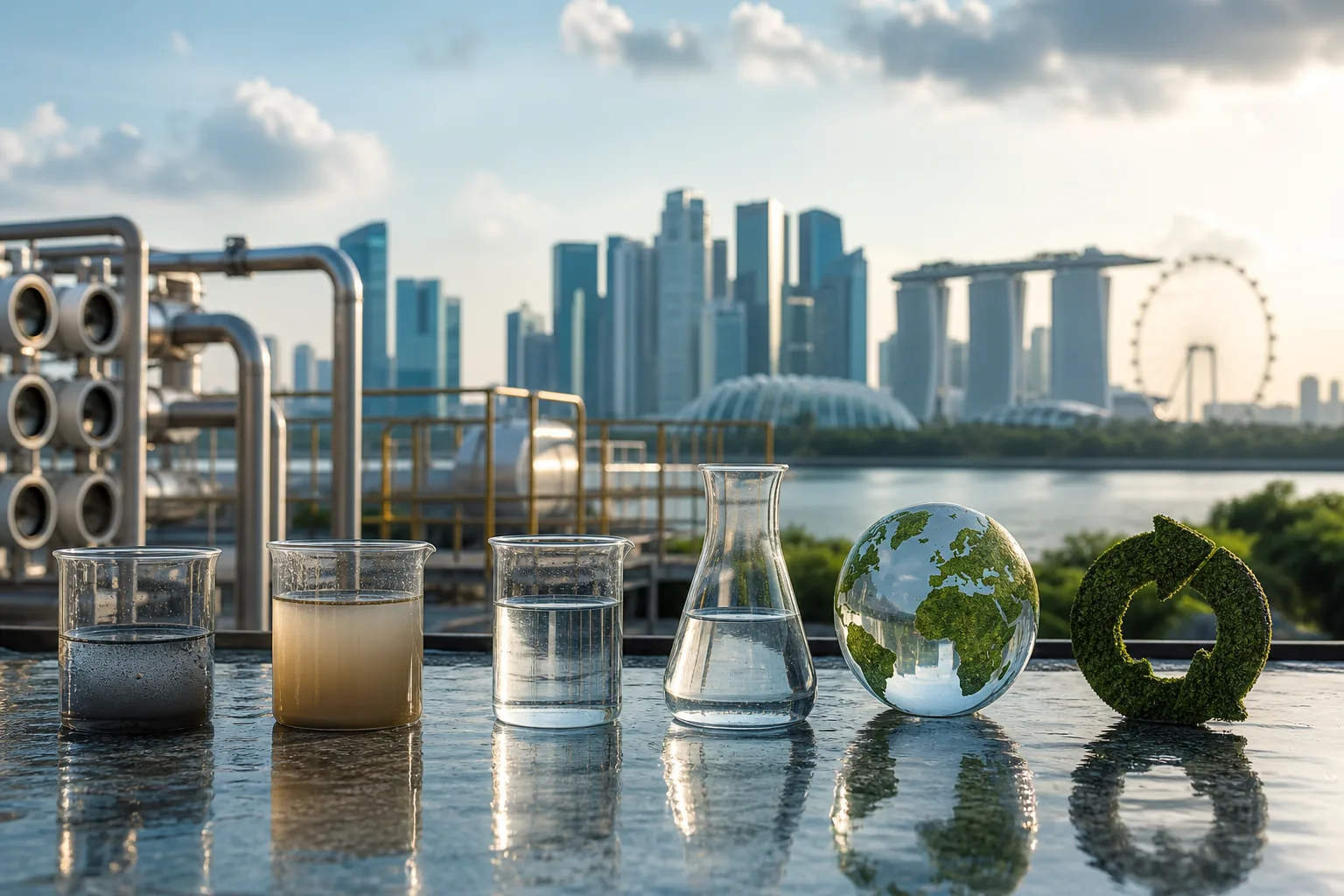
Understand the key criteria and practical comparisons for evaluating industrial water reuse projects in Singapore, including PUB NEWater and MediSun Energy technologies.
You’re reviewing three reuse proposals before the next capital meeting. Each claims a workable payback, yet one assumes cleaner feedwater, another uses a different electricity basis, and a third leaves residual handling outside the project boundary. You still can’t tell which number reflects your Singapore site, or what Industrial Water Reuse Economics in Singapore means in practice.
Most industrial water reuse projects don’t have a technology problem. They have a comparability problem. Market forecasts and technology rankings may shape your shortlist, but they don’t give you a site-specific SGD answer. Your process water, discharge limits, energy exposure, and production risk all affect the business case.
A useful comparison tests every option against the same lens: water cost, electricity, treatment scope, waste liability, recovered-resource value, integration risk, and payback evidence. That lets you compare PUB NEWater with MediSun Energy’s Reverse Electrodialysis and CO₂ mineralization approaches, while showing which assumptions still require a site study.
Start with the source stream and end use, not the technology label. The screen covers municipal reclaimed water, process wastewater, desalination brine, and concentrated industrial residuals, matched to the quality your process requires.
That context matters in Singapore. PUB reports that the country produces one in ten of the world’s semiconductors, data-centre capacity may rise by more than a third, and water-intensive sectors account for about 17% of non-domestic water demand. A consistent screen is more useful than one universal score.

Include an option only when its treatment principle, target stream, and industrial use are documented. Keep published evidence separate from assumptions that require a water audit, laboratory testing, utility quotation, or engineering study.
Market growth and membrane leadership cannot establish comparable economics. A high score means a good fit for defined boundary conditions, not guaranteed savings. That distinction allows a fair screen of PUB NEWater, membrane-led reuse, electrochemical treatment, and MediSun Energy’s brine-management technologies.
Practical rule: Require every proposal to show the same water balance, energy basis, residual liability, and SGD payback assumptions.
A proven reclaimed-water benchmark tells you more about supply confidence than about your factory’s total reuse cost. You still need the industrial tariff, connection cost, energy use, storage, and process-polishing requirements.
NEWater is Singapore’s established reference point. The supplied Elsevier review describes island-wide indirect potable reuse using membrane treatment and advanced oxidation, while also discussing electrochemical development. It is useful for benchmarking, but it isn’t an automatic answer for every industrial site.
Economic snapshot: Compare delivered PUB water with an on-site boundary that includes capital, electricity, maintenance, conveyance, storage, residual handling, and quality assurance. Your comparison remains incomplete without a current PUB tariff and site-specific payback.
NEWater suits sites that need dependable reclaimed-water supply or ultra-pure polishing, particularly when a proven national system matters more than recovering value from a difficult waste stream. An Elsevier review published in April 2018 reported that reuse supplied an average of 30% of Singapore’s water demand. That is a reported review figure, not current 2026 plant-level operating data.
The same review projected NEWater’s share could reach 55% by 2060 and production could rise to 440 million imperial gallons per day. Treat both as planning forecasts, not guaranteed future capacity. The review’s publisher was Elsevier.
NEWater does not automatically solve your brine or industrial waste liability. The delivered-water price may exclude extra conveyance, storage, polishing, and process-specific treatment. Compare those costs with on-site recovery before choosing.
Use it when your site needs a dependable reclaimed-water benchmark and verified quality, not a shortcut around a full boundary-level business case.
For a site managing desalination brine or concentrated industrial waste, the water bill may be only part of the cost. Disposal, transport, compliance, and energy burdens can disappear from a water-only comparison.
MediSun Energy’s Reverse Electrodialysis suits sites where energy-efficient ion separation can fit the existing brine train. The case depends on stream composition, flow, salinity, pretreatment, membrane configuration, electricity price, operating hours, and recovered-stream value. It isn’t simply an alternative to buying NEWater.
Economic view: A weak case counts only water produced. A strong case compares avoided disposal and recovered-resource value with capital, maintenance, measured energy use, and residual handling.

This route suits sites with a concentrated stream, a disposal liability, and a credible destination for recovered materials. Competitor pages discuss membranes and electrochemistry broadly, but they don’t isolate brine management as an industrial payback lever.
You still need pilot testing, uptime checks, maintenance planning, and measured energy consumption. Use it when your site can show that recovered-stream value and avoided disposal exceed installed and operating costs.
Some waste streams may carry value beyond water savings. MediSun Energy’s CO₂ mineralization connects industrial residuals or desalination brine with captured or supplied carbon dioxide, producing stable mineral materials while reducing disposal exposure. The assessment covers resource value as well as treatment cost.
The business case must test feed composition, contaminants, CO₂ sourcing, reaction conditions, energy demand, product quality, customer demand, avoided disposal, and verification. A mineral product has value only when there’s a defined outlet, specification, and responsible accounting method.
This route may suit a factory or desalination site seeking measurable residuals reduction alongside decarbonization. MediSun Energy offers a circular option, but the project still needs staged material testing, pilot validation, product-market review, lifecycle accounting, and commercial integration.
You may face added handling, verification, energy, and market-development work. Use it when your site can prove a responsible mineral outlet and measurable residuals reduction alongside decarbonization.
Before approving a Singapore reuse project, set one comparison basis. Each route addresses a different cost problem, so a headline payback can mislead when tariffs, integration work, residuals, and resource revenues are treated differently.
The scorecard keeps those differences visible and avoids inventing SGD prices where the available evidence doesn’t support a like-for-like quotation.

| tool | best for | strength | limitation | price band |
|---|---|---|---|---|
| PUB NEWater | Sites seeking an established reclaimed-water benchmark or supply option | Island-wide indirect potable reuse model supported by membrane treatment and advanced oxidation | Industrial tariff, connection economics, site energy and payback are not supplied in the research | Project-specific; verify current PUB tariff and connection costs in SGD |
| MediSun Energy Reverse Electrodialysis | Desalination brine and concentrated industrial waste streams | Potentially energy-efficient ion separation combined with brine management and resource recovery | Requires stream characterization, integration design, pilot validation and residual planning | Project-specific; obtain an SGD capital and operating proposal |
| MediSun Energy CO₂ mineralization | Manufacturers and desalination operators combining waste reduction with decarbonization | Potential value from avoided disposal, carbon management and mineral-resource outputs | Depends on feed composition, CO₂ handling, product demand and verification requirements | Project-specific; model SGD costs and recovered-resource revenues |
Treat the price column as a diligence task, not a ranking. The supplied research supports Singapore’s technology direction, but it doesn’t provide comparable site-level capital, operating, tariff, connection, or payback figures.
PUB reported that leading Taiwanese semiconductor companies recycle above 85% of their water, using each drop 3.5 times before discharge. According to PUB, that shows the direction of industrial efficiency, not a Singapore performance assumption.
Price the water balance, energy basis, integration scope, residual handling, and resource outlet for your site. The scorecard identifies those priorities, not a universal winner.
Your choice depends on the site, not a universal ranking. Semiconductor, biomedical, pharmaceutical, manufacturing, and desalination operations face different water-quality, energy, residual, and reliability requirements.
Singapore’s industrial water demand makes infrastructure decisions financially material. PUB says Micron Technology is investing S$9.5 billion in a new Singapore semiconductor facility. That scale is one reason to test each route against verified site conditions rather than broad market forecasts.
| situation | better move |
|---|---|
| The site needs an established reclaimed-water benchmark or alternative supply | Use PUB NEWater as the reference case, then verify current tariff, connection, quality and reliability terms |
| Desalination brine or concentrated industrial streams create disposal and energy costs | Investigate MediSun Energy Reverse Electrodialysis with stream testing, integration design and recovery-value modelling |
| The manufacturer needs measurable carbon reduction alongside waste-stream management | Assess MediSun Energy CO₂ mineralization, including CO₂ logistics, mineral demand and verification |
| The process requires ultra-pure or tightly controlled water quality | Define each end-use quality specification first and compare polishing, monitoring, storage and resilience requirements |
| The project team cannot reconcile competing proposals | Issue one common water balance and SGD commercial template to every bidder |

Use NEWater as your benchmark when supply confidence comes first. Verify PUB’s current tariff, connection conditions, quality requirements, and reliability terms for your semiconductor, biomedical, or pharmaceutical process.
For desalination plants and high-salinity factories, investigate MediSun Energy Reverse Electrodialysis. Your model should include avoided disposal, electricity use, integration costs, and recovered-stream value.
If your manufacturing site has meaningful CO₂ exposure and a mineral-product outlet, assess MediSun Energy CO₂ mineralization alongside water and residual costs. Select the route that improves your total water-and-waste balance under verified boundaries.
Current tariff terms, end-use specifications, and a site water audit are prerequisites for a firm Singapore reuse business case.
The supplied research does not provide a current PUB industrial tariff. Confirm the applicable water charge, trade-effluent costs, connection costs, and site account terms directly with PUB before modelling savings. Don’t insert an unsupported figure. Obtain the current charges for your specific account and connection arrangement.
Requirements depend on the end use. Cooling, washing, process water, boiler feed, and ultra-pure manufacturing water shouldn’t share one assumed specification. Define the parameters, monitoring, storage, polishing, and contingency requirements with PUB, regulators, and your process engineers. The result should be a documented end-use water-quality schedule.
NEWater provides a benchmark for reliability and established reclaimed-water supply, but it isn’t automatically cheaper than on-site reuse, brine recovery, or circular-resource systems. Compare delivered supply, treatment, connection, backup, and residual costs for your site. Test NEWater against a verified site water balance.
You can’t trust a payback until every proposal uses the same boundary conditions. Start with site data, not a preferred technology.
Your first working document should show what enters, moves through, leaves, and costs your facility. Keep it to one page.
PUB raised the Water Efficiency Fund cap to S$5 million for eligible audits, recycling equipment, and closed-loop redesign. Verify current eligibility and application conditions before treating it as potential co-funding.
This gives you a common basis for comparing proposals. If every option shares the same page, its payback can be tested. If not, the payback is only an assumption.
For a practical starting point on brine recovery and industrial resource value, MediSun Energy’s technical articles on Reverse Electrodialysis and CO₂ mineralization cover questions faced by desalination operators, manufacturers, engineering firms, and sustainability leaders.