Physical Address
304 North Cardinal St.
Dorchester Center, MA 02124
Physical Address
304 North Cardinal St.
Dorchester Center, MA 02124

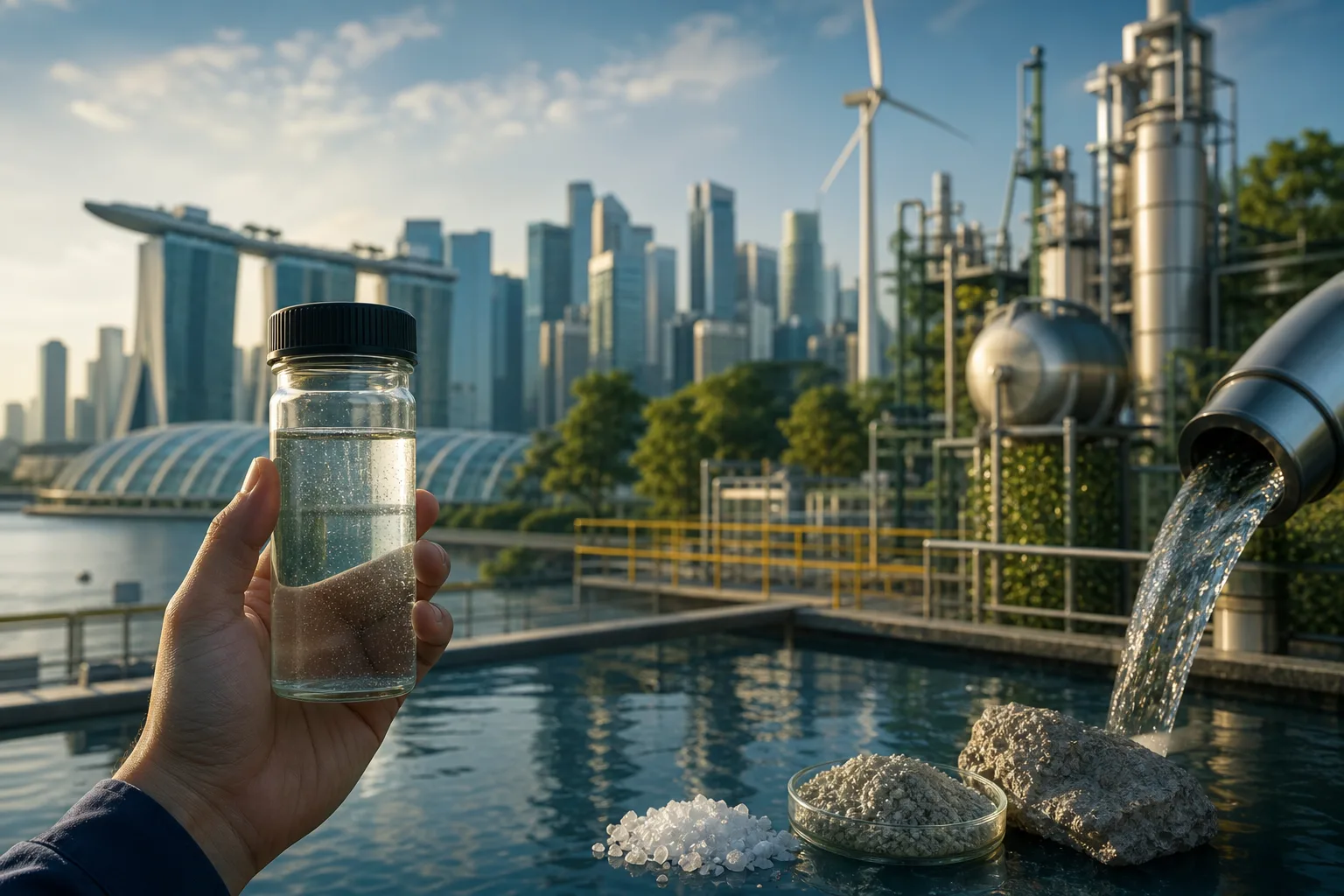
Discover how industrial wastewater resource recovery has evolved from mere compliance to a strategic approach that recovers water, materials, and energy while reducing environmental impact.
At your Singapore plant, the pressure arrives in the same meeting: treatment spending is rising, freshwater demand is tightening the operating budget, and disposal obligations cannot wait. You still have to protect production, maintain compliance, and show a credible path to lower environmental impact. Industrial wastewater resource recovery may help, but wastewater management can also be a legal obligation tied to your licence to operate, not an optional improvement.
Most industrial wastewater programs don’t have a treatment problem. They have a resource-selection problem. The question is no longer only how to remove contaminants, but what each stream can become: recovered water, a feedstock for CO2 mineralization, managed brine, or a combination of these routes.
When you hear “industrial wastewater resource recovery,” you should expect a decision framework, not a generic treatment menu. The right route depends on the stream, its chemistry, the available energy, and the value of the recovered output. MediSun Energy’s Reverse Electrodialysis and CO2 mineralization capabilities may fit some streams, but not all.
You are no longer assessing wastewater only as a compliance cost. Industry guidance now treats each stream as a possible source of reusable water, lower disposal volumes, recovered materials, or carbon-linked value. Treatment remains necessary, but disposal is no longer the only endpoint.
On September 10, 2024, Almawatech described wastewater reclamation as recycling wastewater streams for other applications, particularly where you need to reduce freshwater use and operating costs. The same source states that reclamation can reduce freshwater consumption, wastewater volume, and pressure on natural resources. Alfa Laval presents the wider circular-business case: you can reuse, recycle, or sell by-products to create savings or an additional revenue stream.

Resource recovery is not simply an equipment purchase. Almawatech, Alfa Laval, and Sener discuss treatment, reuse, or circularity, while competitor pages from Gradiant, Saltworks Technologies, Aquatech, Water Technologies, Redstack, and Sweetch Energy vary in their emphasis on membranes, brine, energy, or project delivery. You still need to ask which route creates the highest value for your specific stream.
“Wastewater reclamation is the process of recycling wastewater streams to make them usable for other applications,” according to Almawatech.
Editorial requirement: Before publication, verify a 2026 Singapore announcement, project milestone, or official regulatory source. The supplied research does not establish a current local trigger, so you should not imply that one exists.
For Singapore manufacturers, water recovery affects production demand and discharge management at the same time. Desalination operators face a parallel brine question: should a concentrated stream be managed as a disposal liability, processed for resource recovery, or assessed alongside energy use? MediSun Energy brings Reverse Electrodialysis and CO2 mineralization into that assessment, although your stream chemistry may rule out either route.
Practical rule: Move each stream from “dispose” to “recover, reuse, or convert” only after its chemistry, volume, energy demand, and end market are verified.
You need more than a treatment catalogue to choose a recovery route. Start with composition, salinity, suspended solids, organic and chemical loads, available CO2, potential product users, energy intensity, and residual-disposal risk.
Your plant data must separate verified results from assumptions. Alfa Laval reports that thorough separation and water reuse can reduce operating costs while recovering materials that might otherwise be lost. The decision depends on whether your stream supports a useful output, not simply whether a process can treat it.

Use this four-stage diagram before requesting a design:
Assess CO2 mineralization when your waste chemistry can react predictably, your CO2 supply is dependable, and a product or sink has been identified. MediSun Energy’s CO2 mineralization can fit that screen, but impurities, permanence, product specifications, and residual handling still require sampling or pilot validation.
Before: “The plant has alkaline wastewater, so mineralization should work.”
After: “The Tuas facility has verified alkalinity, a contracted CO2 source, and a confirmed mineral product user.”
Assess brine management before adding further concentration when salinity, disposal constraints, and energy demand dominate the decision. MediSun Energy’s Reverse Electrodialysis deserves screening where ion movement, integration conditions, and energy performance are suitable. It is not a fit without compatible chemistry and a verified plant connection.
Alfa Laval reports that decanter dewatering can return water from sludge to plant processes, while wet-scrubbing solids may create additional revenue. Its guidance also identifies separation followed by evaporation as a route to higher water recovery with controlled energy use.
| situation | better move |
|---|---|
| Water remains embedded in sludge or wet solids | Assess dewatering so recovered water can return to plant processes before disposal. |
| Wet scrubbing slurry contains recoverable solids | Separate and evaluate solids for recycling or sale, while measuring residual disposal risk. |
| A stream needs higher water recovery and has an energy-sensitive duty | Evaluate separation followed by evaporation, using verified energy and reuse-quality data. |
| Desalination brine has significant salinity and an integration opportunity | Screen MediSun Energy’s Reverse Electrodialysis and downstream brine-management options against energy, composition, and disposal criteria. |
| An industrial stream has compatible chemistry and a dependable CO2 source | Assess MediSun Energy’s CO2 mineralization pathway, including product demand, permanence, impurities, and residual handling. |
Your treated-water volume is only one part of the business case. Waste chemistry, carbon availability, energy demand, product value, and residual disposal can decide whether recovery works for your plant.
Research from ScienceDirect describes wastewater as a source of resources that can support value-added products, not only a treatment burden. Sener also frames recovery and reuse around water, energy, nutrients, and circular solutions. For you, that means choosing an outcome before choosing a technology.

First test whether your wastewater contains compatible minerals and whether your site has a dependable CO2 source. MediSun Energy can assess CO2 mineralization as one route, although it still depends on product demand, impurity control, and responsible handling of residuals.
Don’t approve mineralization because the technology name sounds suitable. Confirm feed chemistry, carbon quality, permanence, energy use, and who will accept the resulting material. Industrial recovery may require several treatment stages. Veolia’s documented example combines oil-removal technologies rather than relying on one process alone.
Your brine strategy must account for salinity, energy demand, plant integration, and downstream disposal. Reverse Electrodialysis may create an energy and resource-recovery opportunity for some streams, but you still need verified composition, operating data, and a credible residual pathway before selecting it.
MediSun Energy brings brine management and Reverse Electrodialysis together, but site conditions determine fit. A high-salinity stream with limited electrical capacity may require a different sequence from a plant with spare energy and nearby reuse demand.
Engineering firms should examine how recovery fits existing controls, pumps, membranes, storage, and maintenance routines. Agencies should define success across water, energy, nutrients, materials, emissions, and residuals, not treated-water volume alone.
A named operator, engineer, or policy voice should still be added through reporting before publication. That interview should test the failure case directly: what happened when a project selected recovery by technology name without proving chemistry, integration, or offtake?
“Wastewater contains important resources that should be recovered,” according to ScienceDirect’s 2020 research review.
A verified record gives you a better starting point than a technology shortlist. You can show what enters your treatment system, what leaves it, and where energy, carbon, and disposal costs sit.
Your first task isn’t choosing equipment. It is building evidence that MediSun Energy can test against Reverse Electrodialysis or CO2 mineralization criteria.
List every wastewater, concentrate, and brine stream at your Singapore site. Record its source, flow, temperature, pH, salinity, solids, organics, contaminants, variability, treatment route, and current disposal cost.
Identify available CO2 sources, including concentration, purity, pressure, and operating schedule. Then name potential users for recovered minerals, salts, water, or other materials before you assume a product has value.
Biological treatment can produce biogas when microorganisms decompose organic substances without oxygen, according to Almawatech. That evidence does not prove your stream suits biological recovery or that biogas is your best route.
Compare the proposed recovery route with your current treatment and disposal baseline. Quantify electricity, heat, pumping, chemicals, residual solids, maintenance, control changes, and the consequences of variable feed chemistry.
Require sampling, laboratory testing, and pilot work before you make a commercial commitment. A promising chemistry result still needs to function with your plant equipment, controls, operators, and discharge obligations.
Put the evidence on one current page before requesting a design or comparing equipment. This page gives you a disciplined brief for MediSun Energy and prevents technology-first selection.
Start with one current stream and one named carbon source. A recovery design should follow verified evidence, not lead it.
If you want a faster way to turn plant data into a recovery brief, MediSun Energy supports desalination operators, manufacturers, engineering firms, and public agencies with integrated brine management, Reverse Electrodialysis, and CO2 mineralization discussions. A design still requires testing and pilot validation. Review its recovery planning resources before sharing your inventory.