Physical Address
304 North Cardinal St.
Dorchester Center, MA 02124
Physical Address
304 North Cardinal St.
Dorchester Center, MA 02124

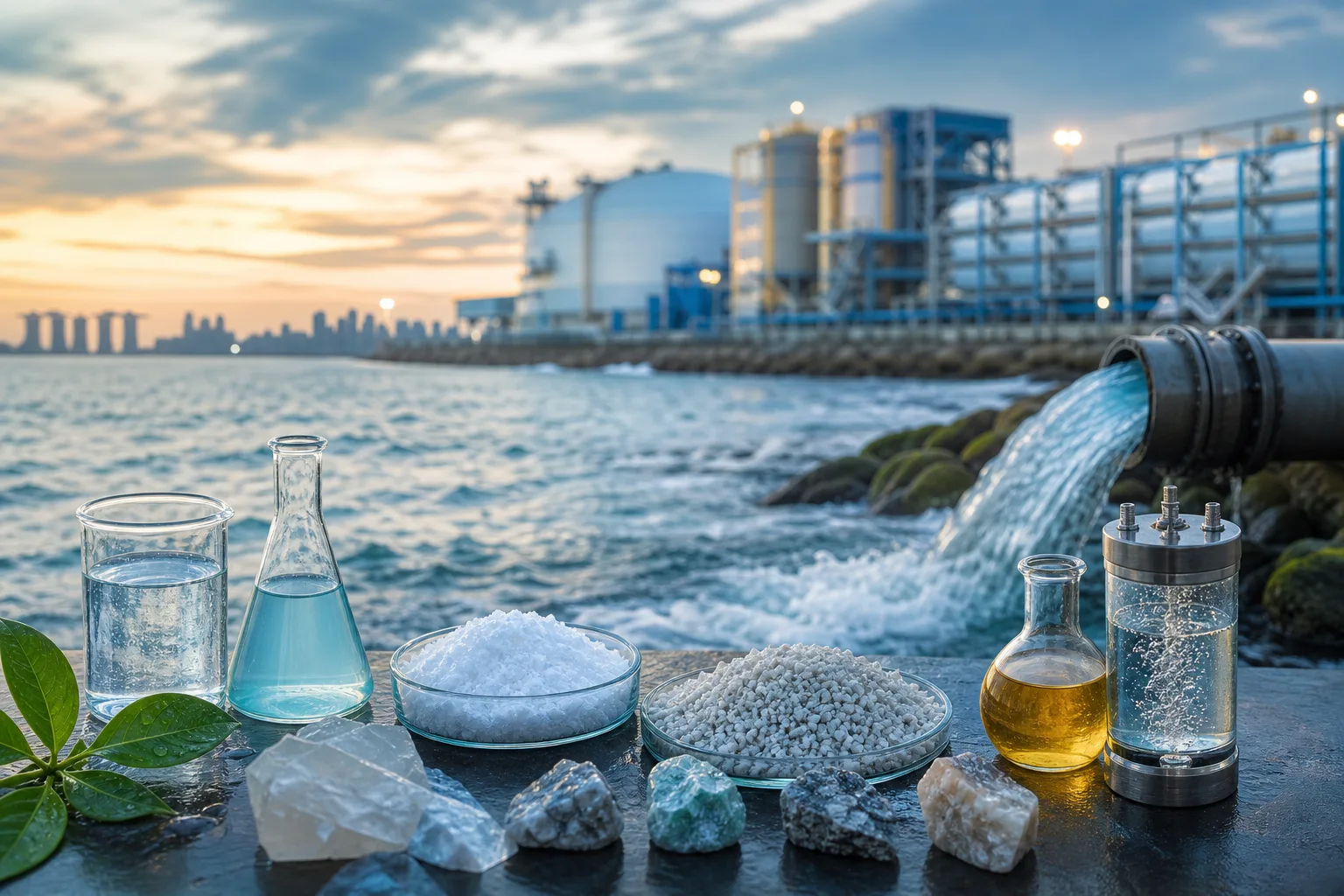
Explore how desalination brine resource recovery integrates chemistry, economics, and site constraints to optimize water and mineral extraction sustainably.
At a Singapore desalination plant, you’re watching concentrate volumes rise while electricity bills, discharge decisions, and decarbonization targets compete for attention. Desalination brine resource recovery offers another route, but potable-water production can’t pause. Every brine-management choice affects permits, operating costs, and the plant’s environmental footprint.
Most desalination operators don’t have a waste problem. They have a separation-and-market problem. Resource recovery shifts brine management away from linear disposal toward recovering water, salts, minerals, and energy, but brine isn’t automatically a valuable commodity. You need to identify recoverable constituents, match them with suitable separation and concentration pathways, test energy and reagent demands, and confirm a buyer before investing. The right pathway depends on where the chemistry, economics, and site constraints meet. MediSun Energy treats desalination brine and industrial waste streams as one integrated management challenge, with circular, energy-conscious options rather than a single universal fix.
You can recover a mineral from desalination brine and still lose money, energy, and time. Your decision must account for disposal exposure, electricity in S$, reagent demand, carbon performance, available footprint, and a buyer’s quality specification.
Concentrate offers a useful starting advantage, but concentration isn’t free. For a Singapore operation, a credible pathway must improve more than one metric at once. The commercial test is chemistry, process burden, and offtake together.

The research identifies two levers to examine: more economical separation and more economical concentration. Applying extraction to desalination concentrate rather than unconcentrated seawater is more energy-favorable, according to Nature’s 2022 review.
That advantage doesn’t erase the energy and capital required to create or handle concentrate. The same review found that extraction from desalination brine has become more cost-competitive with terrestrial mining over the last 10 years. You still need to test pumps, membranes, reagents, heat, footprint, and integration with your existing treatment trains.
A product can have technical value without a dependable market. Nature’s 2022 review warns that commercial development of non-sodium-chloride products depends heavily on the availability and economics of the NaCl market. You therefore need a buyer, accepted specifications, logistics, and a price assumption before selecting a recovery pathway.
MediSun Energy uses an integrated assessment across brine, industrial waste streams, energy, and product demand. That approach doesn’t remove the need for buyer qualification, but it helps you avoid choosing a technology before checking the whole system. A proposal centered only on one mineral, membrane, or product may miss your disposal and decarbonization constraints.
Practical rule: Screen the recoverable resource, total process burden, and confirmed offtake together before you select a pathway.
For a Singapore site, the screen is simple: resource quality, process burden, and buyer readiness. The strongest option fits all three, not merely the one with the most attractive chemistry.
Better recovery decisions come from treating brine as a sequence of streams, not a single waste liquid. For a Singapore plant, that sequence starts with what the concentrate contains and ends with a product specification, water target, or carbon-use case.
Validate each stage with a mass balance and a pilot. Chemistry may show promise, but variability, energy demand, fouling, and buyer requirements decide whether the pathway works.

Characterize salinity, major ions, hardness, organics, trace metals, temperature, flow, and variability first. Then define the intended output, such as a purified salt stream, recovered water, a mineral feedstock, or an alkaline stream for CO₂ mineralization.
Before: Your draft process for a Tuas desalination site says, “Recover magnesium from brine,” with the nanofiltration stage set to “not assessed.”
After: Your process brief names the target grade, allowable impurities, daily flow range, sampling plan, and buyer specification before selecting equipment.
Separate broad constituent classes first. Nature identifies nanofiltration as a promising route because it can create enriched or depleted streams with relatively low energy and reagent input.
You might use nanofiltration to divide multivalent ions from a more monovalent stream, then send only the suitable fraction onward. That reduces the burden on later concentration and precipitation steps.
You can concentrate a selected stream through membrane or thermal stages while recovering additional clean water where the system allows it. Research indexed by ScienceDirect describes integrated concentration steps that can increase overall plant recovery.
Nature reports that advances in osmotically assisted reverse osmosis are making concentration more economic. Water Online describes monovalent streams reaching 200,000–250,000 mg/L before crystallization through osmotically assisted reverse osmosis or membrane brine concentration. That range is an illustrative technical value, not a universal design target.
Precipitate, crystallize, or convert the concentrated stream only after testing purity, yield, energy use, and offtake. A product that requires excessive polishing may not improve your brine economics.
You can assess MediSun Energy’s Reverse Electrodialysis as an energy-conscious salinity-gradient or separation step within an integrated brine route. Its role depends on your feed chemistry, voltage requirements, stream quality, and validated mass balance.
You can also connect suitable alkaline brine or industrial residues with captured CO₂ through MediSun Energy’s CO₂ mineralization capability. This may support decarbonizing desalination and heavy industry, but you still need pilot testing, permanence checks, product qualification, and a confirmed use case.
You can lose months by choosing a target mineral before proving what your concentrate contains. A reverse-osmosis plant typically recovers 30–50% of its feedwater, according to Nature, but actual brine also reflects seawater chemistry, pretreatment, operating conditions, and industrial inputs.
Mineral recovery research is attracting growing scientific attention, according to Springer Nature. That momentum is useful, but it doesn’t prove that a site has viable chemistry, affordable energy, or a buyer. Run failure checks before extraction claims become capital decisions.

If you treat every brine as the same feedstock, you may specify the wrong membranes, reagents, or crystallizer. A weak approach says, “Recover magnesium from Plant A brine.” A stronger approach identifies sodium, magnesium, calcium, sulfate, silica, organics, temperature, pH, and seasonal variation before selecting a separation class.
Class-based separation works better. Group dissolved salts, alkaline streams, suspended solids, and carbon-reactive components, then test each route against a measured mass balance.
You may chase a high-value trace component while leaving the dominant sodium chloride stream without a credible outlet. That weakens plant utilization and revenue. Before targeting a minor mineral, check local salt specifications, competing supply, transport costs, storage needs, and buyer acceptance.
A weak case says, “The pilot recovered 98% of lithium.” A stronger case says, “The route produces 4 tonnes per day of specification-grade salt, with a named Singapore buyer and a tested outlet for the remaining stream.”
Your yield isn’t your margin. Pumps, pretreatment, membrane replacement, cleaning, reagents, electrical or thermal concentration, drying, and solids handling may consume more value than the recovered product creates.
Compare the full energy and chemical balance, not one laboratory result. MediSun Energy can assess integrated brine and industrial-stream routes, including CO₂ mineralization, although site chemistry and pilot validation still limit what any route can promise.
Extraction becomes commercial only when you have a product specification, stable production rate, qualified buyer, storage plan, and transport route. You also need evidence that impurities remain within the buyer’s tolerance.
Broad explanations, downloadable papers, and academic reviews don’t answer the same question. You need to know whether a source explains the concept, provides technical evidence, or tests commercial viability for a Singapore project.
Water desalination brine resource recovery is the evaluation and treatment of high-salinity concentrate to recover additional water, salts, minerals, energy, or usable chemical products. Instead of relying only on discharge or disposal, you assess which resources the brine can support, then match treatment to product quality, operating cost, and buyer requirements.
You can find a desalination brine resource recovery PDF through the publisher’s article page, where you can verify the authors, publication details, and available file. A PDF gives you a convenient format for downloading, searching, and sharing technical material, but don’t treat an unverified copy as authoritative. Check the original publisher before using it in a project.
A review of resource recovery from seawater desalination brine covers separation technologies, concentration methods, candidate resources, energy and reagent demands, market dependence, project economics, and the gap between laboratory research and commercial viability. Read it as a synthesis of evidence, not a promise that one mineral route will work at every Singapore site. MediSun Energy may support implementation, but site testing still decides feasibility.
You have enough information to move from a promising recovery idea to a testable project. The first task isn’t choosing equipment. It’s putting the feedstock, buyer, site, and operating limits on one page.
That discipline helps you avoid a costly pilot built around an unstable stream or a product nobody will purchase. EBSCO identifies Reverse Electrodialysis as one way to use salinity gradients for energy recovery, but site data must decide whether it belongs in the design.
Start by mapping your desalination brine and nearby industrial streams. Record flow, composition, variability, existing treatment points, discharge arrangements, and sampling gaps before discussing process equipment.
Choose the target product and potential buyer before selecting a separation route. You need quality specifications, acceptable impurities, packaging or delivery requirements, and evidence that an offtaker can receive the material.
Compare each route by energy, reagents, water recovery, solids handling, fouling risk, and carbon implications. Assess concentration and separation together, because reducing water volume can increase downstream treatment demands.
Test the preferred route against your Singapore site constraints, including footprint, tie-in windows, electrical capacity, corrosion control, worker safety, discharge conditions, and applicable PUB or NEA approvals to confirm during project development.
Put the feedstock map, target product, buyer, preferred route, site constraints, and monitoring needs into one page. You can then ask MediSun Energy to assess where Reverse Electrodialysis or CO₂ mineralization may support the circular design, especially when desalination and industrial streams are evaluated together.
If you want a faster way to assess brine recovery options, MediSun Energy maps feedstocks, evaluates Reverse Electrodialysis and CO₂ mineralization, and helps define integration requirements for operators, manufacturers, engineering firms, and public-sector teams. Explore brine management and resource recovery guidance, with site testing still determining feasibility.