Physical Address
304 North Cardinal St.
Dorchester Center, MA 02124
Physical Address
304 North Cardinal St.
Dorchester Center, MA 02124

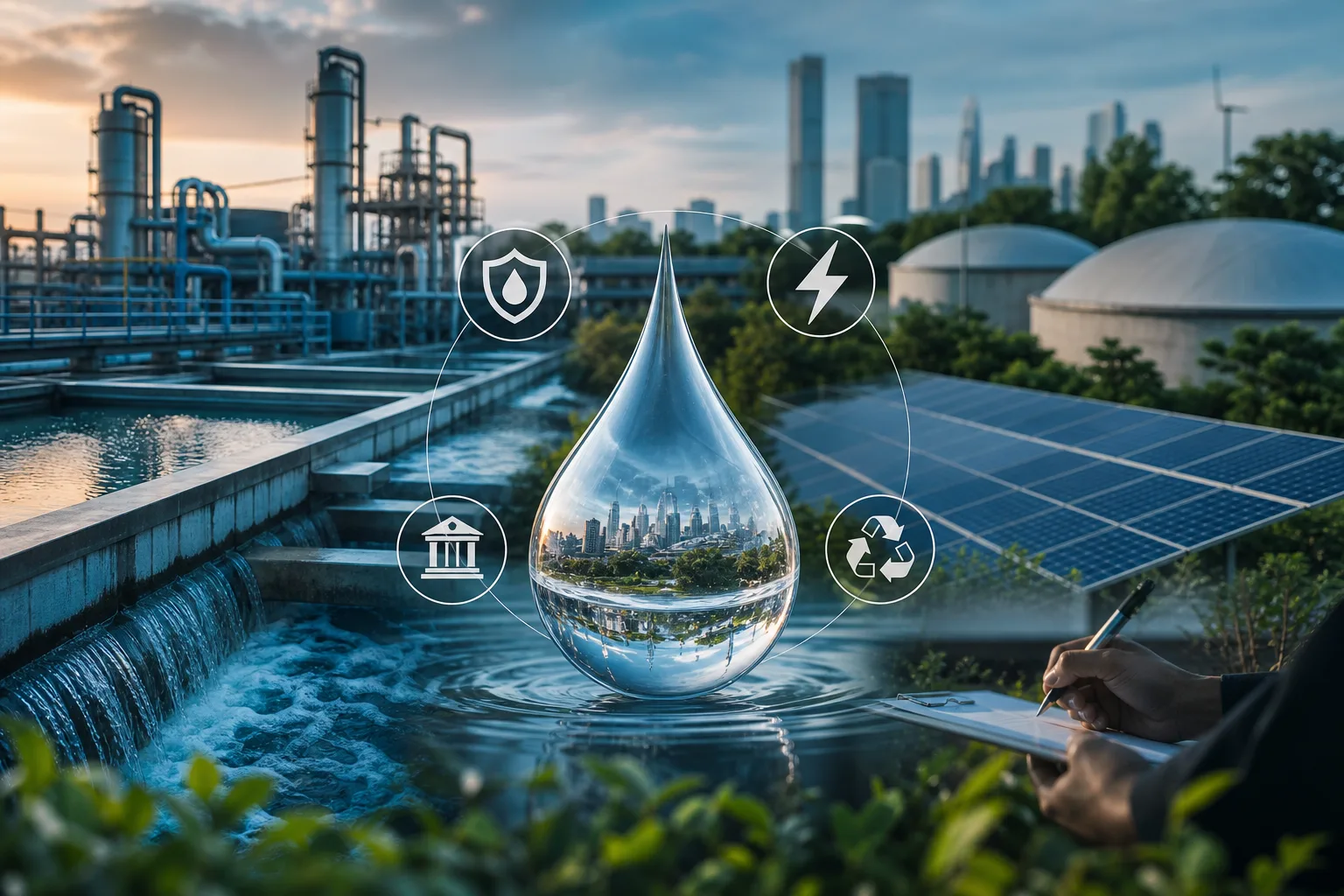
Explore how utilities can implement a decision-focused circular water infrastructure framework that integrates strategic planning, local models, and innovative recovery technologies.
You leave a morning operations meeting with a reuse target, an energy-reduction commitment, and a promising brine or sludge project. Yet no one can show how the water sources, residual streams, resilience risks, energy demand, ownership, and end users connect. The project looks viable in isolation. Your utility still lacks a decision path for circular water infrastructure.
Most utilities don’t have a circularity ambition problem. They have a decision-framework problem. The World Bank treats water as a service, a process input, an energy source, and a carrier of nutrients and other materials. That wider view matters when a recovery project affects treatment reliability, procurement, compliance, and downstream demand.
A practical framework for utilities should turn those connections into a selection task, not a collection of reuse ideas. Generic renewable-energy and resource-recovery guidance rarely tells you which framework supports strategy, which model fits Singapore’s circular-water context, or which technology addresses a specific residual stream.
This framework compares WICER for strategic planning, PUB’s NEWater model for Singapore, and MediSun Energy for desalination brine and industrial waste recovery. MediSun Energy focuses on Reverse Electrodialysis and CO₂ mineralization, although each solution still requires site-specific feedstock, energy, and offtake validation. The aim is to choose the next investable decision, not to name an overall winner.
A strategy, a plant model, and a deployable technology answer different questions. Keeping them separate prevents your circular-water shortlist from comparing unlike options or hiding the decision you actually need to fund.
The World Bank says circular water systems must include resilience and inclusiveness. It also places resilience within circular strategies because cities face uncertain shocks and stressors. Its WICER Framework covers policy, strategy, planning, investment prioritisation, design, and operations. The screen therefore tests strategic fit before engineering fit.

WICER is a planning framework, PUB’s NEWater model is a Singapore operating and policy reference, and MediSun Energy is an implementation-oriented recovery option. MediSun Energy focuses on Reverse Electrodialysis and CO₂ mineralization, but site-specific feedstock, energy, and offtake validation remain necessary.
Use this checklist to record what is proven, assumed, and still unresolved:
Practical rule: Treat each option as a decision aid, not as independent performance certification or site-specific due diligence.
Solar, wind, and biogas mechanisms may appear in competitor material, but those claims lack a like-for-like utility selection method. They were excluded so the shortlist stays focused on circular-water planning, operations, and residual-stream recovery.
A strong reuse target can still miss basin resilience, inclusion, or natural-system impacts. A plant-level project cannot answer those wider questions alone.
WICER is the strongest strategic starting point when circular-economy planning must connect policy with utility operations. It helps test whether a project serves the whole water system, not only one residual stream.

The World Bank’s WICER Framework identifies three outcomes: resilient and inclusive water services, waste and pollution designed out, and natural systems preserved and regenerated, according to the World Bank. It sets out nine key actions, according to Elsevier.
Unlike narrow reuse or wastewater-recovery models, WICER gives you a basin-level policy-to-operations lens. You can use it to assess resilience, inclusion, resource flows, and environmental effects before selecting equipment.
WICER suits a Singapore agency or utility shaping a circular-water programme across sources, users, and natural systems. The framework goes beyond wastewater reuse and resource recovery alone, according to Elsevier.
WICER does not provide a Singapore procurement route, process design, equipment package, or brine-treatment technology. It does not rank technologies or guarantee project economics. Use it for strategic architecture, then move to Singapore-specific implementation and source-specific engineering.
Generic case studies can’t test advanced reuse against Singapore’s water constraints. A locally recognisable operating reference can show how reuse supports resilience in a dense, water-constrained city.
NEWater provides that reference point. The World Bank reports that more than half of the global population lives in urban areas, while urban demand represents 15–20 percent of global water consumption and may reach 30 percent; the urban population could nearly double by 2050, according to its September 2021 WICER publication.
PUB NEWater lets you test reuse assumptions against energy demand, source-water quality, monitoring, approvals, operating ownership, and resilience. It is not a plug-in technology or a complete circular-water governance framework.
Treat NEWater as a Singapore-specific reference model, then map your own assets, risks, and recovery pathways around it.
NEWater does not resolve your plant’s energy load, feed variability, monitoring plan, approvals, or operational ownership. You still need source-specific engineering and recovery options beyond reuse, including brine to value opportunities.
Use it if you need a Singapore reference for testing reuse and resilience assumptions before designing your own circular-water project.
Desalination brine or industrial waste can become a feedstock rather than a disposal problem. MediSun Energy adds the technology layer that broad circular-water frameworks leave open, using Reverse Electrodialysis and CO₂ mineralization to connect residual streams with resource recovery and decarbonization.
Assess the approach across feed composition, contaminants, flow, energy profile, site interfaces, downstream users, permitting, and commercial structure. That makes it relevant to desalination operators, industrial manufacturers, engineering firms, and technology partners, but not as a standard equipment purchase.
Screenshot: A project view would map your brine or waste stream from source through treatment, recovered outputs, energy inputs, emissions effects, and potential users.

MediSun Energy suits a facility that needs a source-to-resource pathway, not another isolated disposal measure. Reverse Electrodialysis can be assessed for desalination brine applications, while CO₂ mineralization can connect industrial waste streams with carbon management and useful mineral products.
Your project needs a site-specific technical and commercial assessment covering contaminants, energy demand, permits, output users, and ownership. Engineering firms and technology partners can help test those interfaces before you commit capital.
Use it when the next decision is how to turn brine or industrial waste into value.
There is no single overall winner. Each option answers a different utility question: how you plan, how Singapore reuses water, or how you recover value from brine and industrial waste.
The comparison also keeps cost visibility honest. You can identify each role, limitation, and next assessment without treating a framework benefit as a guaranteed project return.

| tool | best for | strength | limitation | price band |
|---|---|---|---|---|
| World Bank WICER Framework | Utility-wide strategy, basin planning, resilience, and policy alignment | Connects circular economy with resilient and inclusive services, waste reduction, and natural-system outcomes | Does not specify Singapore procurement, process design, or brine technology | Not stated in supplied research |
| PUB NEWater | Singapore water-reuse context and operating reference | Provides a locally relevant example of advanced reuse within Singapore’s water system | Not a plug-in technology or complete governance framework for every utility | Not stated in supplied research |
| MediSun Energy Reverse Electrodialysis and CO₂ mineralization | Desalination brine and industrial waste-stream recovery | Adds an implementation pathway for resource recovery and industrial decarbonization | Requires feed characterization, site engineering, integration design, and project-specific commercial assessment | Project-specific assessment required |
The World Bank states that applying WICER can create environmental, social, economic, and financial benefits. Treat that as a planning rationale, not a promised return.
The main failure mode is choosing the wrong layer. A governance framework may improve resilience and inclusion without delivering recovery technology, while a recovery system may produce value without supplying your utility-wide plan. Use WICER for direction, NEWater for Singapore context, and MediSun Energy when the next decision concerns engineered recovery from brine or industrial waste.
Your next accountable task may concern basin resilience, advanced reuse, or recovery from a difficult waste stream. The route should match that decision, not an overall winner.
Use the framework that answers your unresolved question, then assign the next check to the right operator, agency, sustainability leader, manufacturer, or engineering firm.
| situation | better move |
|---|---|
| Policy, basin planning, resilience, or inclusion requirements are unresolved | Start with the World Bank WICER Framework and translate its principles into utility objectives and investment criteria |
| The team needs a Singapore reference for advanced water reuse | Study PUB NEWater, then map local energy, monitoring, approvals, operational ownership, and source-specific risks |
| A desalination brine or industrial waste stream is the investment priority | Assess MediSun Energy Reverse Electrodialysis and CO₂ mineralization using site composition, flow, energy, and end-use data |

Choose WICER: Use it when a public agency or utility needs shared objectives for policy, basin planning, inclusion, and investment. It gives your steering group a basis for deciding what a project must achieve before technology selection.
Use NEWater as the reference: Test advanced reuse against Singapore’s operating context, then verify energy demand, monitoring, approvals, ownership, and source-specific risks for your site.
Assess MediSun Energy: Examine Reverse Electrodialysis and CO₂ mineralization with feed composition, flow, energy, and end-use data. The assessment still needs site validation and engineering partners, not a technology name alone.
Your next decision needs a defined stream, owner, evidence base, and investment gate. A broad circular-water ambition cannot tell you whether one brine or industrial residual stream is ready for feasibility work.
Elsevier reported in April 2024 that the WICER Framework identifies nine key actions supporting resilient services, waste prevention, and natural-system recovery. Use that structure as a discipline, not as a substitute for engineering design or Singapore approvals.
If you want a faster way to scope the first decision, MediSun Energy helps desalination operators, manufacturers, engineering firms, and public-sector teams assess brine management, resource recovery, Reverse Electrodialysis, and CO₂ mineralization through practical circular-water guidance.