Physical Address
304 North Cardinal St.
Dorchester Center, MA 02124
Physical Address
304 North Cardinal St.
Dorchester Center, MA 02124

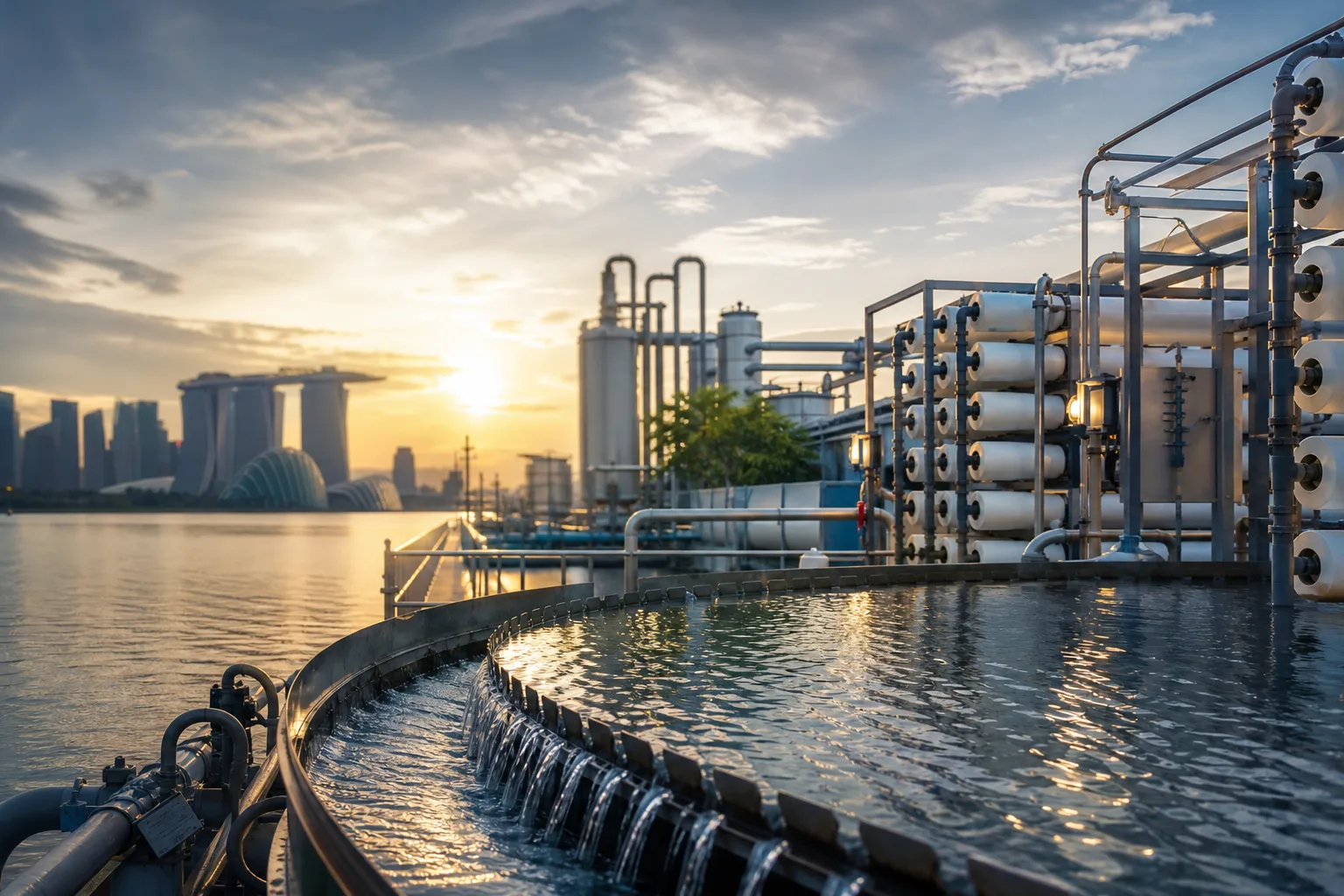
Understand how desalination plants can balance recovery, energy use, and environmental compliance by choosing between Zero Liquid Discharge and Zero Liquid Release strategies.
Before sunrise, you’re reviewing a desalination plant’s brine balance while operators wait for a decision on the next upgrade. The concentrate is harder to manage, environmental scrutiny is rising, and every treatment option adds energy demand, chemical handling, or approval risk. In Singapore, the discharge boundary must also meet public-sector expectations for careful water stewardship and resource efficiency. That makes Zero Liquid Discharge vs Zero Liquid Release: What Desalination Plants Should Target a practical engineering question.
Most desalination plants don’t have a no-liquid problem. They have an end-state problem. You may be able to prevent liquid release to natural surface waters without forcing every dissolved salt into on-site crystals. Zero Liquid Discharge generally leaves solid residues as the final waste, while Zero Liquid Release focuses on stopping liquid escape beyond an accepted containment or recovery boundary.
The decision comes down to recovery, energy, chemistry, solids handling, approvals, and resource recovery. MediSun Energy’s circular brine-management approach may fit some plant balances, subject to your chemistry, integration constraints, and accepted release boundary.
Your next brine decision doesn’t have to begin with full thermal Zero Liquid Discharge as the assumed endpoint. WC&P’s technical update of 1 January 2026 presents high-recovery membranes, Minimum Liquid Discharge, and selective thermal treatment as an integrated pathway for reducing residual brine before final treatment.
That is a technical industry update, not evidence of a newly announced Singapore mandate. You still need a site-specific approval route, monitoring plan, and accepted release boundary. The engineering discussion now centres on matching recovery to your water chemistry, energy limits, solids route, and circular-water target.

Conventional reverse osmosis recovers about 50–80 percent of feedwater, leaving roughly 20–50 percent as concentrated brine containing salts, organics, and metals, according to WC&P’s 1 January 2026 update. The first design question is therefore recovery depth, not simply whether a plant carries a ZLD label.
You can see Minimum Liquid Discharge shrink the residual brine stream by 60–90 percent, according to WC&P’s 1 January 2026 technical update.
Full thermal ZLD may suit a site where liquid discharge is unacceptable and crystallised solids have a verified handling route. It isn’t automatically the best fit when staged membrane recovery and selective thermal treatment can reduce the remaining stream first. Choosing the endpoint before selecting every treatment step may lower thermal duty, equipment footprint, and solids burden.
Practical rule: Set the accepted liquid boundary and recovery target first, then test whether membranes, selective thermal treatment, or full ZLD provides the lowest-risk route for your plant.
The decision affects more than plant operators. Engineering firms integrating treatment, industrial water users reducing waste streams, water-technology companies assessing Reverse Electrodialysis, and government agencies setting circular-water targets all need the same distinction: an industry pathway doesn’t replace Singapore approval, discharge monitoring, or proof of where recovered water and solids go.
For Singapore projects, document the proposed boundary, residual chemistry, energy demand, solids destination, and monitoring method before calling a design zero liquid discharge or zero liquid release. An integrated route can support resource recovery and decarbonizing desalination. MediSun Energy’s circular brine-management technologies may fit some balances, subject to site chemistry, integration constraints, and accepted release conditions.
Your plant boundary determines whether concentrated brine remains a liquid problem or becomes a managed solids stream. That distinction matters when you compare membrane recovery, mechanical concentration, evaporation, and crystallization.

Zero liquid release is broader than a treatment label. Define which liquids may leave the site, under what approval, and with what monitoring evidence. Set your engineering target as recovery first, solids last, and release only by design.
With zero liquid discharge, you prevent liquid waste from leaving your facility, recover water for reuse, and leave dissolved material as dry crystals or other solid residues. The MDPI definition describes ZLD as a way to minimise liquid waste while extending water supply, according to its 2021 study. WC&P states that a ZLD system aims to leave no liquid waste leaving the facility, with recovered water reused and only solid residues remaining, according to its 1 January 2026 technical update.
When you design zero liquid discharge desalination, you take the reject stream beyond conventional RO. Conventional RO recovery is commonly represented at roughly 50–80%, leaving concentrated brine for further management. You add concentration, evaporation, or crystallization so your final boundary contains water for reuse and solids for controlled handling.
The comparison is practical, not cosmetic. You can use MLD to reduce the brine volume requiring final treatment by 60–90%, while a ZLD design targets roughly 90–95% recovery or more. You may achieve more than 90% recovery with a fluidized-bed crystallization reactor, according to WC&P, but that result alone doesn’t make your plant full ZLD.
With MLD, you materially shrink the residual brine stream without necessarily eliminating the final liquid. When you choose ZLD, you add the final evaporation or crystallization burden, higher energy demand, solids handling, and disposal or reuse decisions.
| what changed | before | after | who it affects |
|---|---|---|---|
| Liquid-waste endpoint | Concentrated brine remains after membrane treatment | Water is recovered and only solid residues remain in a full ZLD configuration | You, when you need a no-liquid-outfall design |
| Brine volume | Conventional RO leaves a substantial reject stream | MLD can shrink the residual brine stream by 60–90% | You, when you want to reduce downstream thermal equipment |
| Recovery pathway | Membrane recovery alone is limited by scaling, osmotic pressure and fouling | Membrane, mechanical and selective thermal steps are integrated | You, when you’re designing a high-recovery process train |
| Final treatment burden | All concentrated liquid requires management or discharge approval | ZLD adds evaporation or crystallization to produce managed solids | You, when your site has strict release boundaries or limited disposal options |
For your design review, the illustrative recovery range runs from 50% to 80% for conventional RO, reaches above 90% for reported fluidized-bed crystallization, and sits around 90–95% for the ZLD reference range. MediSun Energy can support some integrated brine-to-value routes, although your chemistry and accepted solids destination still limit the suitable endpoint.
For a Singapore desalination operator, the choice isn’t simply whether to install full Zero Liquid Discharge. Decide what release boundary your approval pathway can accept, then test the energy, chemistry, downtime, and solids consequences of meeting it.
Zero Liquid Release can prevent liquid waste from reaching natural surface waters without requiring thermal crystallization for every kilogram of brine. Full ZLD may remove liquid discharge altogether, but your plant then inherits evaporation, crystallization, scale control, corrosion-resistant equipment, and a permanent solids destination.
The better procurement target is the endpoint you can monitor and prove, not the most absolute label.

IAEME reports that full ZLD for bulk seawater desalination can require 6.73 to over 47 kWh/m³ when reverse osmosis reject is processed into dry crystals. That range makes a site-specific energy assessment essential before you select thermal equipment.
"Zero Liquid Release is an operational strategy in which no liquid waste escapes into natural surface water bodies," as defined by IAEME.
Before procurement, write two configurations. Weak: “Install ZLD for maximum compliance.” Strong: “Set a monitored ZLR boundary, quantify residual brine and energy, and confirm a permitted solids route before selecting crystallization equipment.” That comparison shows whether your project needs full ZLD, staged MLD, or resource recovery first.
Before approving a tender, you need more than a technology label. Your Singapore project requires a defined boundary, a defensible cost basis, a suitable process partner, and evidence that the proposed operating model meets its approval conditions.
Zero discharge means no unauthorised liquid leaves the defined plant boundary, but the phrase is incomplete without that boundary. Define liquid pathways, stormwater interfaces, bypasses, monitoring points, and the destination of accepted residual solids. Weak: “Zero discharge achieved.” Strong: “No process liquid leaves the approved boundary, and all residual solids have a documented destination.”
A generic Singapore dollar figure would be unreliable because your cost depends on flow, salinity, contaminants, pretreatment, recovery target, footprint, automation, energy source, materials, and solids disposal. Request a site-specific capital and operating-cost model covering power, chemicals, maintenance, replacement parts, testing, and residuals management.
An India-based supplier may suit your project, but its country of origin doesn’t prove Singapore integration, performance, or approval suitability. Assess the complete process train, including pretreatment, concentration, crystallization, controls, commissioning support, and evidence from comparable chemistry. MediSun Energy offers integrated brine management, although its fit still depends on your site data and selected endpoint.
ZLD compliance is documented conformity with your applicable approval, monitoring, sampling, operating, and reporting conditions. Purchasing equipment alone doesn’t establish it. You must show how the plant prevents unauthorised liquid release, records performance, manages bypasses, and handles residual solids under the conditions accepted by the relevant Singapore authorities.
You need a project brief that turns the ZLD versus ZLR choice into testable work. Without a defined boundary and measured stream, you risk comparing equipment labels instead of outcomes for your plant.
Start smaller than the procurement package. One page can give your engineers, technology partners, and Singapore approval advisers a common basis for the next decision.
Mark every point where water, concentrate, chemicals, energy, and solids enter or leave your system. Include intake, pretreatment, reverse osmosis, internal reuse, concentrate treatment, outfall, evaporation, and final solids handling.
Your one-page balance is the first task, not an appendix. It gives MediSun Energy and your project team a defensible starting point for circular treatment, Reverse Electrodialysis integration, resource recovery, and CO₂ mineralization decisions.
Treat the following checklist as a decision gate. Procurement can proceed only when each item has an owner, evidence source, and acceptance condition.
If you want a faster way to turn your brine data into a defensible project brief, MediSun Energy supports desalination operators and industrial manufacturers with Reverse Electrodialysis, CO₂ mineralization, and circular resource recovery decisions. Explore the brine management and resource recovery guidance for the next technical discussion.




