Physical Address
304 North Cardinal St.
Dorchester Center, MA 02124
Physical Address
304 North Cardinal St.
Dorchester Center, MA 02124

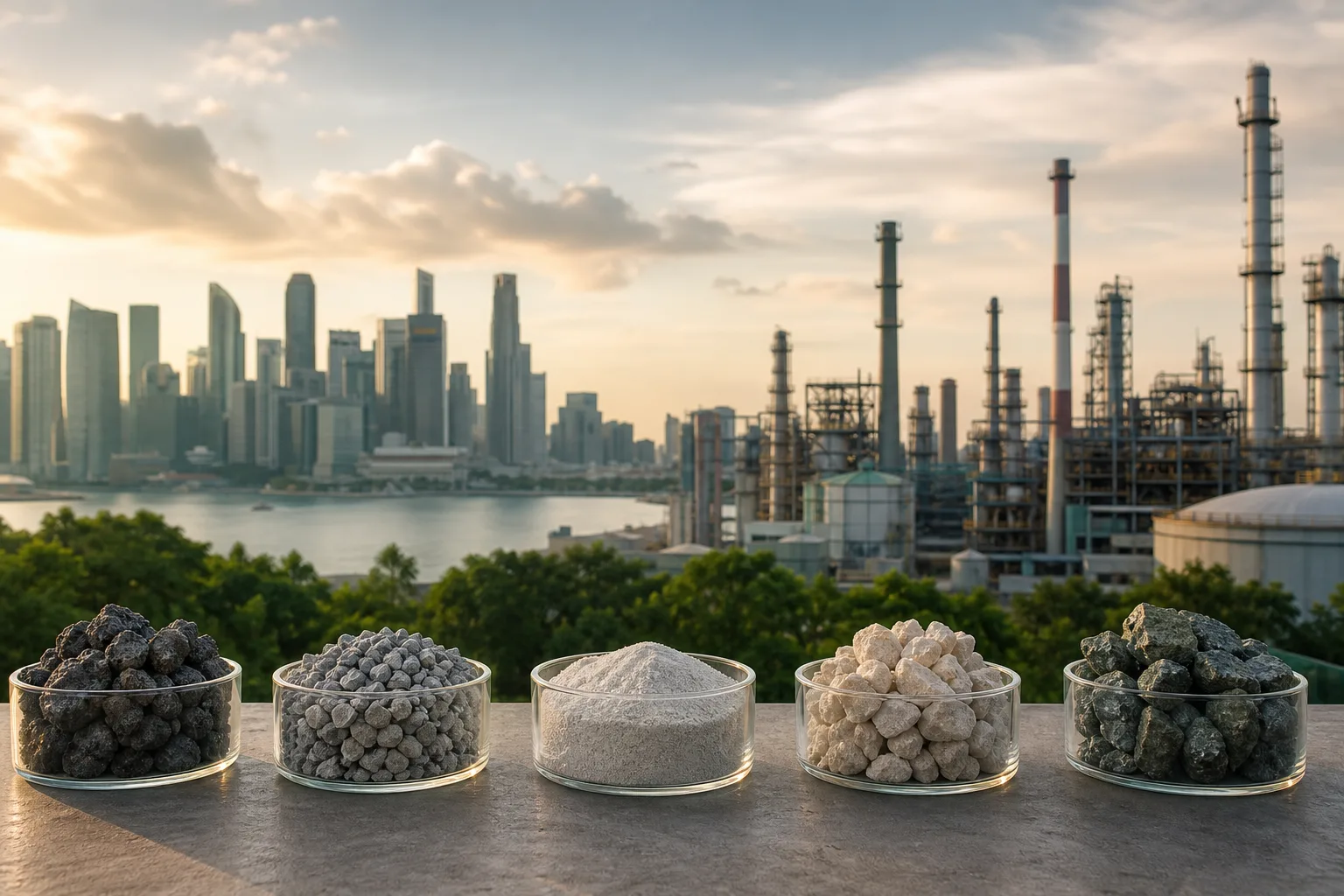
Understand how CO2 mineralization transforms industrial emissions into stable carbonates, addressing feedstock challenges and integration for sustainable operations.
Your capture system is running, but the shift handover still carries bad news: alkaline residues need a destination, concentrated brine needs management, and the monitoring team cannot yet explain how stored carbon will be verified. You may know where process CO2 leaves your Singapore facility without having a practical plan for the materials and energy that follow. That is where CO2 Mineralization Basics for Industrial Emitters begins.
Most industrial emitters don’t have only a CO2 capture problem. They have a feedstock and integration problem. Carbon mineralization converts CO2 through chemical reactions into a solid carbonate. Carbon Capture Journal describes the process as converting carbon dioxide into a solid mineral, such as a carbonate, within the storage material. That formation helps prevent the CO2 from escaping later.
You need more than chemistry to assess a mineralization project. The right route depends on your feedstocks, CO2 sources, integration requirements, permanence claims, and verification tasks. Storage capacity, energy demand, and feedstock quality may still limit the case, even where the chemistry works.
A provider’s claim that alkaline waste can store carbon isn’t enough. Your site needs a measured feedstock, a compatible CO2 stream, a credible carbonate product, and a destination for everything left over.
This screen tests commercial fit in Singapore rather than theoretical potential. It separates laboratory promise, pilot evidence, and deployable project capacity.

The shortlist includes named mineralization providers with an identifiable industrial pathway. Research papers, geological storage concepts, and market-report categories were excluded.
Engineering Conferences International estimates that global mine waste could store 100-200 Mt of CO2 per year. At individual sites, passive mineralization is typically limited to 1-50 kt/yr and constrained by CO2 supply. The same publisher reports that initial continuous-flow dissolution may release only 5-10% of total cations. Labile cations represent accessible capacity, while recalcitrant cations are unlikely to repay costs at current carbon prices.
Reject any option lacking mass balances, feedstock assays, operating evidence, monitoring plans, or commercial pricing. Those exclusions test real Singapore deployment instead of treating every tonne of alkaline material as equally valuable.
Practical rule: You should not count mineralization capacity until your feedstock assay, CO2 supply, energy demand, and product destination support the same operating case.
Can your Singapore facility manage concentrated brine, industrial residues, and captured CO₂ without creating separate waste problems? MediSun Energy assesses those streams together, allowing you to examine chemistry, energy demand, and resource recovery within one project case.
Its approach combines desalination brine and industrial waste streams with CO₂ mineralization and Reverse Electrodialysis. You can assess whether your site has suitable feedstock, manageable pretreatment, available electricity or heat, and a useful destination for carbonate-containing output.

Site view: Your feasibility screen connects brine composition, industrial residues, CO₂ supply, energy inputs, carbonate output, verification, and Singapore permitting review.
The buying question isn’t only how much CO₂ your material might react with. You also need a consistent feedstock and a credible route for the resulting resource.
MediSun Energy suits a desalination operator or industrial manufacturer that wants brine management, decarbonizing desalination, and resource recovery assessed together rather than as separate projects.
MediSun Energy’s limitation is practical: your site needs project-specific design before storage capacity, product yields, or Singapore permitting requirements can be stated. Use it if you can submit site data for a feasibility assessment based on your actual brine, waste, CO₂, energy, and product conditions.
Can your captured CO2 become a construction input rather than another storage problem? CarbonCure Technologies suits you when a ready-mix or precast concrete plant can receive conditioned CO2, control dosing, and qualify the resulting product for customers.
You get a defined utilization route, but not a waste-stream-first design. The main integration point is concrete production, so you must assess plant operations, product quality, monitoring, and Singapore market acceptance together.

You would connect captured CO2 delivery and conditioning to controlled dosing at the concrete plant. Weak fit: you send desalination brine to a concrete facility without testing its chemistry. Strong fit: you deliver conditioned CO2 to a precast line with documented dosing, quality checks, and a buyer-approved product specification.
Screenshot: You would expect to see CO2 conditioning, dosing control, batch records, quality assurance, and the destination product mapped in one operating view.
Unlike MediSun Energy’s integrated brine-management pathway, CarbonCure places the concrete product at the centre rather than the waste stream. You must align CO2 conditioning, plant operations, product qualification, monitoring, and market acceptance before evaluating the route. Use it if your procurement brief covers concrete standards, chain of custody, monitoring, and the destination market.
Could your captured CO₂ become mineralized aggregate instead of another managed waste stream? Blue Planet Systems suits you when a construction-material supply chain can receive carbonate-bearing aggregate and your site can connect feedstock preparation, CO₂ delivery, quality control, and transport.
You must test the whole chain, not just the chemistry. Surface mineralization differs from deep injection because crushed rock exposes more reactive area. Carbon Capture Journal identifies two primary approaches and names basalt and ultramafic rock as relevant hosts.

The pathway gives you a downstream product route distinct from direct brine management. Research reported by Carbon Capture Journal found that mine-waste mineralization can proceed faster than underground injection because crushed rock offers more surface area for mineral formation. Pilot work also reported basalt mineralization in under two years, but you must not treat that finding as Blue Planet Systems’ guaranteed operating rate.
Your screening image should show captured CO₂ entering conditioned alkaline material, followed by aggregate testing, storage, delivery, and a Singapore construction customer.
Choose this route when you can prove carbonate formation, aggregate performance, manageable logistics, and customer acceptance together. You will need feedstock characterization, CO₂ delivery limits, leachability testing, transport distances, and specifications accepted by your construction customer.
Slow release from recalcitrant cations can limit your conversion rate, even when a fast labile fraction performs well. Use it if you can secure a suitable alkaline feedstock and CO₂ supply, validate operating kinetics, and prove that your construction market can absorb the output.
Mineralization chemistry is only one part of the comparison. Your decision also depends on who controls the alkaline feedstock, where the carbonate-containing output goes, and how much integration your site can absorb.
The available research supports chemistry and cation-release limits, but it does not provide comparable public project prices. Treat each price band as a custom-quote category, not as an invented Singapore-dollar estimate.

| tool | best for | strength | limitation | price band |
|---|---|---|---|---|
| MediSun Energy | Desalination operators and industrial sites assessing brine or waste-stream management alongside CO2 mineralization | Integrated evaluation of brine management, Reverse Electrodialysis, CO2 mineralization, energy use, and resource recovery | Requires project-specific feedstock analysis, process design, permitting review, and commercial validation | Custom quote; public project pricing not supplied |
| CarbonCure Technologies | Emitters with access to concrete production and a construction-product destination | A defined downstream concrete integration pathway for mineralized CO2 | Less direct for desalination brine, mine tailings, or waste streams requiring treatment before use | Custom quote; public project pricing not supplied |
| Blue Planet Systems | Emitters evaluating mineralized aggregate and construction-material supply chains | A product pathway centered on carbonate-containing aggregate | Requires suitable feedstock, CO2 delivery, aggregate qualification, logistics, and customer acceptance | Custom quote; public project pricing not supplied |
Headline removal claims are not interchangeable. MediSun Energy fits sites that must assess brine, industrial waste, energy use, and resource recovery together, while CarbonCure and Blue Planet focus more tightly on construction-product destinations.
Make the next comparison about site constraints rather than brand ranking. Check feedstock ownership, CO2 delivery, product qualification, permitting, logistics, and customer acceptance before requesting a project quote.
Your site constraint matters more than a headline removal claim. You may need brine treatment, a qualified construction product, or a reliable outlet for alkaline residues.
For Singapore projects, chemistry, utilities, monitoring, and procurement evidence must align before you choose a route. The better option is the one that fits your feedstock and delivery limits.

| situation | better move |
|---|---|
| Desalination operator with brine-management and resource-recovery needs | Start with an integrated MediSun Energy assessment covering brine chemistry, mineralization, Reverse Electrodialysis, energy use, and output destination |
| Concrete manufacturer with an established product route | Prioritize a concrete-integrated mineralization pathway and verify CO2 conditioning, product qualification, monitoring, and customer acceptance |
| Mining or mineral-processing site with alkaline residues | Characterize labile cation capacity, feedstock variability, CO2 delivery limits, reaction rates, and aggregate or disposal options before sizing the project |
If you manage concentrated brine, start with co-design rather than a standalone reactor. Assess brine chemistry, energy demand, resource recovery, and the final output together.
If your concrete plant already has a product qualification route, prioritize integration into that route. Verify CO2 conditioning, testing, monitoring, and customer acceptance before treating capacity as usable removal.
Crushed materials can expose more reactive surface area, but your tailings and brines may behave differently. Test labile cation capacity, reaction rates, variability, and CO2 delivery limits first.
Require this checklist before comparing suppliers or removal claims:
A staged feasibility process will give you a safer procurement decision than a single headline removal figure.
Your next decision needs site evidence, not another generic mineralization claim. Begin with one page showing what enters your facility, what leaves it, and which constraints will shape integration.
That brief helps you test whether a laboratory reaction can become a permanent, energy-efficient, commercially workable project.
Send this brief to MediSun Energy or another shortlisted provider. It gives you a basis for testing permanence, energy efficiency, and commercial fit before detailed design, without confusing a laboratory reaction with a deployable project.
If you want a faster way to turn site data into a practical screening discussion, MediSun Energy assesses brine, industrial waste streams, CO2 sources, and integration constraints for operators, manufacturers, and infrastructure teams. Explore MediSun Energy’s articles on circular brine management and CO2 mineralization before requesting a structured feasibility conversation.




