Physical Address
304 North Cardinal St.
Dorchester Center, MA 02124
Physical Address
304 North Cardinal St.
Dorchester Center, MA 02124

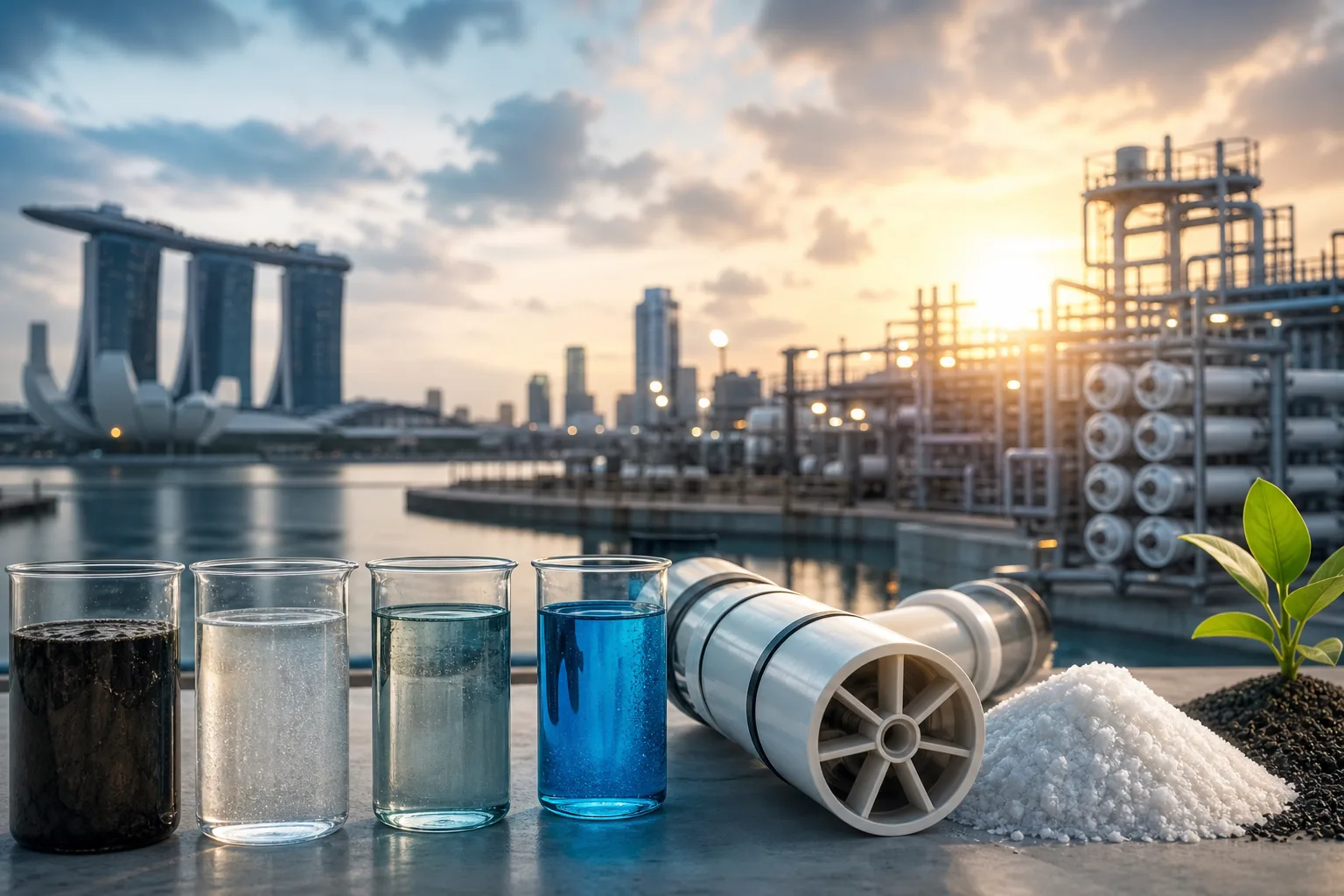
Explore practical brine recovery options including NTU’s membrane system, TU Delft’s simulation tool, and MediSun Energy’s integrated approach, focusing on site fit and energy impact.
At the morning operations review, you’re weighing desalination brine against pumping loads, storage capacity, monitoring duties, compliance requirements, and disposal arrangements. A recovery idea may look promising on paper, but your stream chemistry, flow, site infrastructure, and local buyers will determine whether it works. For Singapore operators and industrial sustainability leaders, brine management is a daily operating decision, not an abstract waste category.
Most brine management projects don’t lack technology. They lack a clear fit between the proposed process and the site, backed by evidence. Before moving ahead, you need to test energy demand, carbon impact, permitting, infrastructure needs, and whether a credible buyer exists for the recovered output.
This comparison covers NTU’s diafiltration-nanofiltration-reverse osmosis system, TU Delft’s simulation tool, and MediSun Energy’s integrated approach using Reverse Electrodialysis and CO₂ mineralization. The strongest-sounding option isn’t necessarily the right one for your site.
You need more than a promising recovery claim to assess a brine solution. Each candidate here has a named mechanism or tool, an identifiable application or development pathway, and enough public evidence for you to judge deployment fit.
The shortlist combines a process flow sheet, a modelling tool, and an integration partner. Delft University of Technology’s 2025 assessment found that higher water and salt recovery can increase energy use and carbon emissions, so you need a whole-system test rather than a recovery-rate ranking. Its study compared four configurations with different recovery, energy, and environmental trade-offs.

You should be able to trace what each option does, where it fits, and what must change around it. Broad disposal claims and generic resource-recovery categories fail that test because you cannot assess their operating mechanism or deployment pathway.
You will not see unsupported claims, unnamed process categories, or pages that describe an idea without enough evidence for due diligence. This screen addresses a gap in typical pathway rankings, which often explain trade-offs without applying one consistent buyer-facing test.
Practical rule: Before you compare vendors, confirm that you can explain your stream, mechanism, integration needs, energy penalty, and output buyer in one project brief.
Could your SWRO plant separate useful ions before brine becomes highly concentrated? This NTU process is designed for that point in the flow sheet, using diafiltration and nanofiltration to fractionate divalent and monovalent ions before reverse osmosis concentration increases scaling pressure.
You get a defined three-stream arrangement rather than a general mineral-recovery claim. NTU describes a divalent-enriched Br1 stream for Mg(OH)2 recovery, a monovalent-enriched Br2 stream for high-grade NaOH extraction, and product water. That gives you a clearer basis for hydraulic, energy, footprint, and offtake checks.

You can assess the process as a pretreatment-stage flow sheet for seawater reverse osmosis. By separating ions earlier, the design reports lower energy consumption, reduced fouling tendency, and improved mineral recovery efficiency. It also proposes lower membrane-area requirements and energy recovery devices to reduce pumping demand.
Process snapshot: You would evaluate three outputs: Br1, enriched in divalent ions for Mg(OH)2 recovery; Br2, enriched in monovalent ions for NaOH extraction; and product water. NTU identifies three resulting streams in its process description.
You may find this strongest where seawater chemistry, product offtake, and existing SWRO hydraulics support staged separation. Singapore operators should test available footprint, intake conditions, energy accounting, and buyers for Mg(OH)2 or NaOH before treating the flow sheet as investment-ready.
You gain a concrete flow sheet, but you also inherit integration questions. Confirm membrane compatibility, Singapore site footprint, pumping loads, energy recovery performance, stream quality, and recovery economics against actual brine data. The process is not a universal replacement for existing treatment.
Use it if your SWRO project can validate chemistry, scale, and recovery economics. Request technical details and test the design against your plant’s brine profile before progressing to detailed engineering.
Could your team compare desalination and mineral-recovery options before ordering equipment? The TU Delft open-source Python model gives you an early decision-support layer, not a treatment plant. You can test integrated configurations and compare economic, environmental, and multi-criteria outcomes.
The apparent winner changes when you alter recovery targets, energy demand, CO₂ emissions, waste heat, cost allocation, functional units, or stakeholder values. That lets you model uncertain Singapore flows and electricity assumptions before committing to hardware.
Screenshot: You would see scenario inputs and comparative outputs rather than a live plant-control interface.

You can compare higher water and salt recovery against rising energy use and CO₂ emissions. A single recovery percentage cannot decide your project.
Model several configurations first, then take the strongest candidates into laboratory and pilot evaluation.
Open-source access supports exploration, but it does not remove uncertainty. Your model may favour a configuration that fails under actual fouling, chemistry, footprint, or Singapore permitting constraints.
Use the tool to narrow your test plan before you evaluate equipment.
Could your brine problem also involve industrial waste, carbon reduction, and recovered-product value? MediSun Energy is designed for that wider brief, rather than for one membrane step or one modelling exercise.
You can use its integrated approach to connect stream characterisation, Reverse Electrodialysis, CO₂ mineralization, and circular-resource project design. The aim is a site-specific pathway for Singapore infrastructure, not an assumed process guarantee.

You can assess desalination brine and industrial waste streams together while considering energy use, carbon intensity, contaminants, permitting, and product offtake. That creates an integration route that isolated tools may not provide.
Project view: Brine stream, industrial CO₂, resource recovery, energy context, validation plan.
This approach suits projects that cross plant boundaries and need an engineering pathway before commitment.
You still need to validate chemistry, flow, contaminants, energy context, permitting, and offtake. MediSun Energy offers an integrated route, but not a guaranteed yield, price, or site result.
Prepare your stream brief and discuss a site-specific pathway with MediSun Energy.
You need a buying view that separates an early model from a process-design candidate and a project partnership. The table below puts each route against the same fields, so you can see scope, maturity, and commercial clarity together.
Price band means the publicly visible commercial path, not the total project cost. Treat every route as subject to chemistry, integration, validation, and site-specific engineering.

| tool | best for | strength | limitation | price band |
|---|---|---|---|---|
| NTU Diafiltration–Nanofiltration–Reverse Osmosis System | SWRO operators evaluating pretreatment ion fractionation and Mg(OH)2 or NaOH recovery | Defined flow sheet with three output streams, reported lower fouling tendency, reduced membrane-area requirements, and energy-recovery integration | Requires site-specific chemistry, process integration, product validation, and commercial enquiry | Not publicly listed; enquiry-based |
| TU Delft Open-Source Python Simulation Tool | Early scenario testing across desalination, water recovery, mineral recovery, energy, carbon, and cost assumptions | Open-source modelling and multi-criteria assessment support before equipment commitment | A decision-support model is not a pilot, equipment package, or deployment guarantee | Open-source; no purchase price indicated |
| MediSun Energy Integrated Brine Management | Projects combining desalination brine, industrial waste streams, Reverse Electrodialysis, CO₂ mineralization, and circular-resource goals | Integrated partnership pathway connecting stream assessment, energy-efficient recovery, carbon reduction, and project design | Scope, performance, integration requirements, and commercial terms are site-specific | Not publicly listed; project-specific |
You can use the NTU route when your brief is a defined SWRO process question. The TU Delft tool fits work before equipment commitment, while MediSun Energy suits a broader project or partnership brief. Site-specific terms limit upfront price comparison for all three.
Your starting point should reflect what you know, what you must prove, and who will use the recovered product. A Singapore project that is still uncertain needs a different first step from one with specialised chemistry or an industrial decarbonization target.
Use the table as a decision map, not a ranking. You still need plant data, regulatory input, engineering review, and product-user commitment before procurement.

| situation | better move |
|---|---|
| The configuration, recovery targets, or cost and carbon assumptions are still uncertain | Use the TU Delft open-source Python model to compare scenarios before selecting equipment |
| An SWRO plant has suitable chemistry and a case for staged Mg-Na fractionation and mineral outputs | Investigate the NTU diafiltration–nanofiltration–reverse osmosis process and request technical details |
| The project combines desalination brine with industrial waste streams or CO2-reduction goals | Approach MediSun Energy for integrated brine-management and circular-resource project design |
| Flow, chemistry, temperature, or contaminant levels vary materially over time | Characterize the stream across operating conditions before choosing a recovery pathway |
| A recovered product has no defined user, specification, or offtake route | Validate product requirements and offtake economics before treating recovery value as project revenue |
If your configuration, waste-heat access, cost allocation, or stakeholder priorities remain open, start with the TU Delft model. A weak brief says, “Test brine recovery.”
Strong brief: “Compare recovery targets, energy use, carbon assumptions, and product routes for the proposed Singapore plant.”
Investigate the NTU process when your SWRO chemistry supports staged Mg-Na fractionation and mineral outputs. Confirm pretreatment, contaminants, energy demand, and integration constraints first.
Approach MediSun Energy when you need brine to value across desalination and industrial waste streams. Its integrated design suits CO₂ mineralization and circular solutions, although scope and commercial terms remain project-specific. Before procurement, model, test, validate, and align operators, engineers, regulators, and product users.
A recovery project starts with evidence, not equipment. You need the stream’s chemistry, flow, variability, disposal cost, and energy context before you can judge whether resource recovery improves your project.
You may find a valuable product pathway, but not every brine justifies recovery. Delft University of Technology reported in 2025 that resource-recovery systems outperformed conventional production for the same product basket. That result supports disciplined screening, not automatic procurement.
You can start today with one page covering the source, flow, chemistry, temperature, variability, contaminants, current disposal route, energy context, and target recovered products.
Ask your engineering team to model recovery yield, energy demand, pretreatment, solids handling, and disposal under several scenarios. Zero liquid discharge can recover water and produce solid crystalline salts, according to the U.S. National Science Foundation, but it does not automatically offer the best economics or emissions profile.
Screen your Singapore regulatory obligations, stakeholder concerns, discharge requirements, land constraints, and product buyers. Compare recovered-product offtake with reuse, treatment, and disposal alternatives before you select a process.
Your first task is the brief. Share it with MediSun Energy for a structured assessment. Resource recovery is a project decision built from local evidence, not an automatic upgrade for every brine stream.
If you want a faster way to turn stream data into a defensible recovery case, MediSun Energy helps desalination operators, industrial manufacturers, engineering firms, and sustainability leaders assess brine, integrate Reverse Electrodialysis and CO₂ mineralization, and shape circular resource-recovery projects through MediSun Energy’s brine management insights.




