Physical Address
304 North Cardinal St.
Dorchester Center, MA 02124
Physical Address
304 North Cardinal St.
Dorchester Center, MA 02124

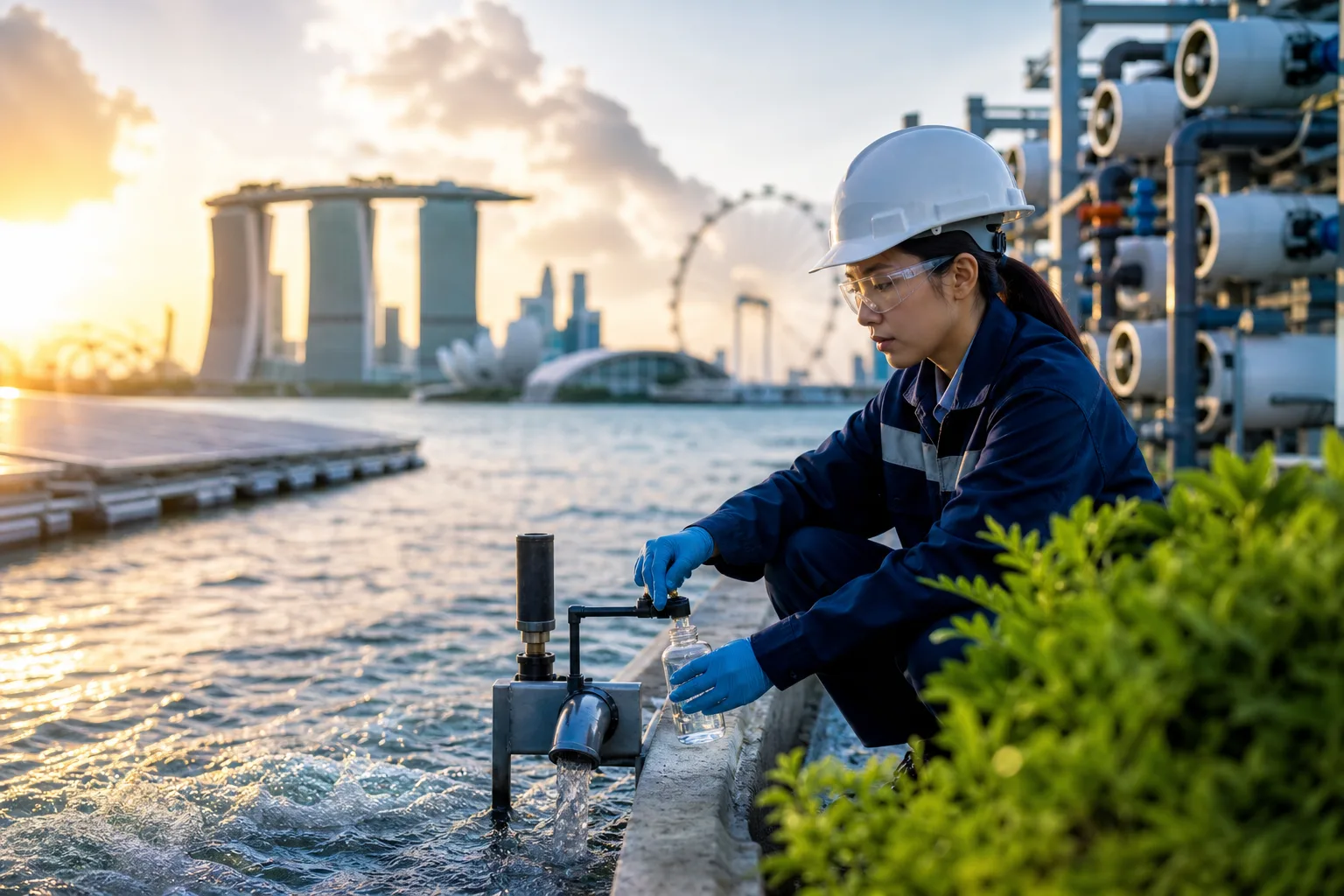
Discover how desalination brine can be transformed into valuable chemicals, minerals, or biomass through energy-efficient processes tailored to your plant's chemistry and local demand.
You’re reviewing the brine line before the next operations meeting. The product water is moving where it should, but the concentrated stream is harder to place as its volume, chemistry, discharge conditions, and site constraints shift. Your disposal route may still work today, yet a small change in contaminants or receiving-water requirements can create a larger operational problem.
Most desalination projects don’t have only a brine disposal problem. They have a resource-matching and validation problem. When someone asks about the beneficial uses of desalination brine, the useful answer depends on feed quality, energy demand, contaminants, permits, process integration, and a credible offtake. Not every stream has commercial value.
Chemical recovery, CO₂ mineralization, and controlled biological conversion can all be worth testing, but attractive ideas still need evidence. MediSun Energy can assess energy-efficient processing and circular resource opportunities. Your stream needs characterization first, followed by a comparison with conventional discharge or disposal.
Could your concentrated brine replace part of your chemical supply? In the right process, electrochemical conversion can recover sodium hydroxide and hydrochloric acid from reverse-osmosis brine rather than treating the stream only as waste.
You need more than a promising reaction, though. The Massachusetts Institute of Technology reported that reverse-osmosis brine can be processed toward these useful chemicals, while CSIRO warns that electrodialysis reversal loses efficiency beyond current-density limits. Your feed chemistry, membrane selection, electricity demand, and nearby offtake determine whether the route works commercially.

Electrochemical cells separate and convert dissolved salts into acid and alkali streams. You may then use recovered sodium hydroxide for cleaning or pH control and hydrochloric acid for industrial dosing, subject to purity testing and safe handling.
MediSun Energy can assess whether energy-efficient brine processing fits your plant, but your stream is not automatically suitable. Calcium, magnesium, silica, organics, and trace contaminants can foul membranes or carry into the products.
You have the strongest case when your plant consumes acid or alkali nearby and can provide consistent brine chemistry. A local user reduces transport, storage, and uncertain sales exposure.
Weak screen: “The plant produces saleable chemicals from brine.”
Strong screen: “A Tuas facility will test sodium hydroxide purity, membrane fouling, electricity demand, and a nearby hydrochloric-acid offtaker before procurement.”
Before integration, you need pilot data, membrane maintenance estimates, chemical storage controls, and an electricity review. In Singapore, confirm discharge, hazardous-chemical, workplace-safety, storage, transport, and product requirements with PUB, NEA, MOM, SCDF, and other relevant authorities before procurement or sale.
Practical rule: Do not call recovered acid or alkali a product until its composition, safety controls, energy cost, and buyer acceptance are documented.
Use it if your brine is characterisable, your electricity supply supports the process, and a nearby user needs chemicals that your validated output can meet.
Could your brine help turn an industrial CO₂ stream into a useful mineral? You may combine brine-derived calcium or recovered chemistry with a suitable CO₂ source to form calcium carbonate, but the reaction pathway, reagent demand, and product quality must be proven for the actual site.
This approach links brine management with industrial decarbonization. Inland brine disposal can account for up to 50% of desalination costs, according to CSIRO. That avoided disposal cost is useful context, not proof of profit.
You need measured calcium and magnesium availability, contaminant levels, moisture, particle size, and end-use specifications before calling the output a product. MediSun Energy’s CO₂ mineralization capability is one option to evaluate against your measured streams, energy supply, and a credible Singapore buyer.
Your strongest case may involve a desalination or industrial site near a cement producer, construction-materials manufacturer, filler producer, or other industrial user. You can then test whether the buyer accepts your carbonate’s purity, consistency, transport requirements, and price.
Your assessment must cover pretreatment, reaction energy, reagent demand, contamination control, permanence, transport, and buyer acceptance together. Use it if your brine chemistry and CO₂ stream are compatible, your carbon accounting is transparent, and a Singapore buyer validates the product before capital approval.
Could your brine-related inputs support a biological product without creating a new compliance problem? Microalgae and other controlled systems are sometimes proposed for biomass or useful compounds, but untreated desalination brine is not a ready-made growth medium.
Your Singapore project needs evidence beyond laboratory performance. The sensible role is a contained pilot with defined limits, monitoring, worker safeguards, and a verified route to market.
Selected microalgae may use suitable salts, nutrients, carbon, or other brine-related inputs to produce biomass and compounds with potential industrial value. You must first confirm salinity tolerance, pH, temperature, nutrient balance, and culture stability.
MediSun Energy could assess this route alongside resource recovery options, although biological conversion remains site-specific and research-stage. You cannot assume a laboratory yield will survive variable brine chemistry, contamination pressure, harvesting energy, or plant-scale operating conditions.
Your strongest case is a contained pilot linked to a defined product pathway, not open cultivation or direct use of uncharacterized brine. You should also document how residual brine, spent culture, and recovered products will be managed.
Your assessment should cover culture stability, trace-metal and organic contamination, harvesting energy, residual-brine management, worker safety, and product permissions. CSIRO states that land application may suit some sites, but you need a site-specific long-term environmental impact assessment. Biological use likewise needs a documented risk and compliance case.
The trade-off is clear: you may gain biomass and resource-recovery value, but you accept biological failure, reactor or land footprint, variable yields, and uncertain product approval. Use it if you can run a contained pilot, prove reliable performance at site scale, and verify who will accept the resulting product.
You cannot choose a brine outlet by product label alone. Your site may suit chemical recovery, CO₂ mineralization, or biological conversion, but each pathway demands different chemistry, equipment, controls, buyers, and approvals.
Use the comparison below to test your actual constraints. The strongest option is the one that improves total system economics, not simply the one that produces the most attractive material.

CSIRO reports that commercial brackish-water reverse-osmosis plants generally recover up to 70% usable water, while electrodialysis reversal may achieve higher recovery below 5,000 mg/L total dissolved solids. A higher recovery target is not automatically better if it increases concentration, energy demand, or residual-brine management costs.
| option | best for | strength | limitation | cost |
|---|---|---|---|---|
| Chemical recovery | Consistent concentrated brine with suitable chemistry and nearby chemical offtake | Can produce defined chemicals such as sodium hydroxide and hydrochloric acid | Requires contaminant control, energy, electrochemical equipment, and safe chemical handling | Site-specific; driven by pretreatment, electricity, maintenance, storage, and offtake |
| CO₂ mineralization | Sites with compatible brine chemistry, a usable CO₂ stream, and a nearby industrial buyer | Can connect brine management with mineral products and industrial decarbonization | Requires product-quality testing, contaminant control, and credible carbon accounting | Site-specific; driven by reaction inputs, energy, transport, quality control, and compliance |
| Biological conversion | Contained pilots using biologically compatible brine and a verified product pathway | May create biomass or usable compounds through controlled biomanufacturing | Performance, harvesting, contamination control, and product permissions may limit scale | Site-specific; driven by reactors, nutrients, monitoring, harvesting, and product validation |
Your Singapore project needs a full-system comparison. Include avoided disposal, electricity, pretreatment, monitoring, transport, permitting, residual management, and the certainty of a paying offtaker. Product value alone can make a weak project appear attractive.
CSIRO identifies evaporation ponds and land application as common inland brine options in Australia, while evaporation ponds suit only small flows and require substantial maintenance to limit environmental impacts. Your Singapore site may face tighter space, discharge, and compliance constraints, so compare each pathway against its complete compliance burden. Chemical recovery may offer the clearest product specification, CO₂ mineralization may add carbon value, and biological conversion may create biomass, but none guarantees reliable returns without site data and buyer validation.
Your next decision depends on site data, not a promising product label. You need enough detail to distinguish a technically suitable pathway from one that adds energy demand, treatment steps, monitoring work, or an uncertain buyer.
CSIRO states that brine management requires site-specific review of environmental impacts, discharge compliance, and economic feasibility. Keep those tests in one screening record instead of assessing resource recovery in isolation.
Keep the first task deliberately small. Create one page your operator, engineer, regulator, and potential technology partner can read without translating a spreadsheet.
Use that page to open a technical discussion with MediSun Energy. The objective is a defensible pilot decision, not a premature promise of zero waste or guaranteed revenue.
If you want a faster way to assess your stream, MediSun Energy evaluates brine recovery, CO₂ mineralization, and Reverse Electrodialysis integration for desalination operators, manufacturers, engineering firms, and sustainability teams. Find practical project guidance in MediSun Energy’s brine management resources.




